Friday, May 27, 2016

GUEST POST: Using Technology to Develop a Student-Centered Math Classroom (Erin Mead)

This is in a series of posts by teachers in the TUSD Connect Fellowship for the 2015-2016 school year. I hope you enjoy reading their reflections on the impact of technology in their classroom, specific tools and strategies that have made a positive impact on teaching and learning, and their goals moving forward.


As I look back on my teaching from last school year to this school year, it has been a whirlwind!  I didn’t realize how much I have changed in how I teach, how I want students to learn, and the amount of technology I have in my toolbelt.  There has been a dramatic change in the way I “teach” and the goal I have for my students, which is to be more active learners.  I have tried to create a learning environment of more self-directed, collaborative learning and less directed instruction.  


GoFormative is an online tool that gives me instant feedback on whether my students are learning and understanding the content.  I can upload a worksheet, or create my own formative assessment.  I can also set whether or not students can see if answers are correct or not.  For CP students, I set GoFormative for students to see immediate results, and they can try to figure out where their mistakes are.  For lower level classes, I do not let them see if answers are correct, and instead watch the results myself and go to students directly that are not getting it, and I also let students know on an individual basis which ones they miss.  The biggest benefit I have seen when using GoFormative is that students will tell me that they understand a concept they didn’t before because they are completing the problems during class where they can work with peers, and I can give individual help when needed, increasing their understanding.


Another tool I have expanded upon in my daily teaching is Haiku. I started using Haiku loosely last year as an additional support of resources for students but I didn’t go a good job of keeping up on it.  I now use Haiku to upload homework and homework answers,so now the daily routine for students is for them to check their answers, which also allows them to check with their peers, then ask questions about problems they miss, saving valuable class time for other learning activities.  I also upload resources that can help students with their learning, such as video tutorials and PowerPoints.  A new way I have used Haiku is for administering assessments (concept checks, quizzes, unit tests).  I can mix up the questions and multiple choice answers so students that seat near each other are not working on the same questions in the same order, and the instant scoring feature saves time in grading.  


For next year, I want to continue to incorporate technology to enhance student centered learning, and continue to add to my toolbelt to support my goals and the environment I have tried to create.  I want to try new tools, like Pear Deck and Desmos, for how I present and engage students in lessons other than PowerPoints, encouraging students to explore and investigate rather than note taking, which will increase their understanding.  I have tried a couple of Desmos activities and I would like to incorporate those more as an alternative to direct instruction.  I feel these tools provide more opportunities for students to discuss the content and work together.

You can see the Desmos Activities I have tried this year here:


The Tech Fellowship positively impacted me indirectly by supporting what I have been striving for in my teaching practices.  It also provided me the opportunity to learn and incorporate technology practices that I would not have taken the time to figure out on my own.  The coaching aspect gave me direction and focus toward my goals of not only learning technology, but also shifting my teaching practices.


Erin Mead teaches Geometry and Algebra at Arnold O. Beckman High School in Irvine, CA.  Her main math love is Geometry and she is constantly searching for meaningful and fun ways for students to learn.  Erin serves as a mentor teacher to beginning teachers in her department, and she is a member of the district’s unit writing team for Geometry.  This year, to improve her teaching practices and use of technology in the classroom, Erin became a tech fellow and has finally caught up to, and maybe even surpassed her students and colleagues with her tech knowledge.  


Wednesday, May 18, 2016

GUEST POST: Teaching with Technology: Reinvigorating Pedagogy in an English-Language Arts Classroom (Tracey Kent)

This is the first in a series of posts by teachers in the TUSD Connect Fellowship for the 2015-2016 school year. I hope you enjoy reading their reflections on the impact of technology in their classroom, specific tools and strategies that have made a positive impact on teaching and learning, and their goals moving forward.

*This post is cross-posted on the Technology Fellowship blog at http://techfellowship.blogspot.com/


Technology has had a noticeable impact on my classroom this year. It has afforded me greater efficiency and reinvigorated somewhat calcified pedagogical knowledge. For my students, it has increased their productivity, accountability, and engagement.

This year, technology has added to my efficiency as an instructor in various ways. In terms of managing the requisite influx of writing assignments, Google Classroom, Goobric/Doctopus, and Turnitin.com have helped to make me a more efficient grader so that I can provide timely writing feedback to my students. Google Drive’s “Suggestion” mode has made leaving digital comments on student work just as easy as writing them by hand. The customizable nature of rubrics via Goobric/Doctopus and Turnitin.com also allows me to give directed feedback to students that pinpoints areas that need improvement. While it has definitely been an adjustment, scoring online is something I feel has improved my efficacy, and as a result, my students’ learning. I also believe that my efficiency with delivering content knowledge has improved with technology. Tools like Haiku and Pear Deck permit me to hone in on the necessary content and become more strategic about the way I deliver such information. These tech tools have helped to effectively disseminate content and have forced me to rethink pedagogy. Although much of the essential pedagogy remains unchanged (pair sharing and group collaboration and lecture all remain as effective instructional methods), technology has allowed for a reinvention of some of what is considered “tried and true.” For example, TodaysMeet and Verso provide another avenue for collaborative discussion. Pear Deck brings interaction and accountability to lecture. Google Drive helps with editing and revision. Ultimately, I have discovered that technology can enhance existing pedagogy by making it more efficient and engaging.

See the end of this post for some examples of my lessons utilizing these tools.

Technology has also impacted student productivity, accountability, and engagement in my classroom. With the aid of technology, students are able to produce more, in that certain activities once bound to class time are no longer confined to the classroom. Online discussion boards like Verso allow for conversation to continue outside of class, which extends discussion activities. Students are also able to produce differently with technology. For example, instead of using a poster, students can use a Google Drawing for a visual project. The change in how and where assignments are produced inevitably leads to increased engagement and student learning. I polled my junior honors English classes about how much the various tech tools we have used this year enhanced their learning, and approximately 80% said that Google Drive and Google Classroom greatly enhanced their learning while 73% said these tech tools “positively impacted their interest” in learning the content. 


Furthermore, sites like Actively Learn, Curriculet, and Pear Deck hold students accountable. With these tools, students cannot passively listen to a lesson or read a chapter. They provide the teacher with valuable feedback to help modify and refine instruction. In a survey of my sophomore class, 72% of students said that online reading tools like Curriculet or Actively Learn engaged them in their task because it helped them to better understand the information. One student wrote “ I think it was more engaging because there were questions to be answered as we read and it helped us to focus on what we were reading and remember.” Ultimately, I believe that student learning was positively influenced by my use of technology this year.


In the future, I plan to continue to explore what technology has to offer as an instructional aid. Technology aids instruction and learning in myriad ways, but it is important to remember that there is no replacement for good teaching. Much of my experience as a Tech Fellow this year has reinforced that idea. The process of building purposeful lessons and reflecting on teaching practice is what makes an effective teacher. Though technology brings new ways to engage students and greater efficiency, the content and pedagogical knowledge of a trained, living-breathing teacher is a combination that is not replaceable. Students need teachers who teach them how to learn and think, and technology can be a tremendous asset to skilled teachers who know how to use it to complement instruction.

Here are a few of my favorite lessons from the year and how the technology supported the learning goals.

Google Docs / Google Classroom / Goobric / Doctopus
Student essay with teacher comments submitted to Google classroom: Students completed an essay on The Glass Menagerie using a Google doc that they submitted to Google classroom. This enabled students to complete a peer review activity in which they were asked to highlight topic sentences, evidence, and commentary. They were also asked to provide a comment with the number of sentences of analysis and commentary. Then, students made corrections, de-selected highlighted text, and submitted the assignment again to Google classroom. Here I scored it using the Goobric/Doctopus extensions and made similar comments on their work.
Student essay rubric attached with Goobric/Doctopus in Google classroom


Google Drawings


Student group project Google drawing: To learn rhetorical strategies (ethos, pathos, logos, etc.), my sophomores were asked to design their own app and market their product to their classmates. They are asked to create their own advertisement and “commercial” presenting their product. During their presentation, they must provide a visual aid (Google drawing) that incorporates various rhetorical strategies.


Verso
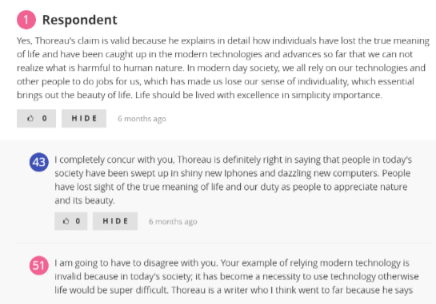
Verso discussion: Students were asked to post a comment to the discussion board before class after reading an excerpt of Thoreau’s Walden. Before the start of the period, I grouped the responses according to those who agreed or disagreed with Thoreau’s central argument. In class, we reviewed the comments on Student Mode (student comments are anonymously displayed) before we began a discussion of the specific techniques Thoreau uses to espouse his position.


Pear Deck

Sample Pear Deck lecture on Modernism : To introduce the literary movement Modernism, I asked my students to review content on Haiku. The following day, I used Pear Deck to ask students to demonstrate their understanding of the information read for homework. For example, they were asked to define key terms from the reading. Pear Deck enabled me to make a lecture-based lesson more interactive, in that I was able to check for understanding throughout class and display and clarify student answers. At the end of the lecture, students received a “takeaway” transcript from Pear Deck in their Google drive containing the answers they provided as well as the slideshow itself.


Actively Learn / Curriculet

Actively Learn reading assignment: My sophomores used a site called Actively Learn to read some of the core works (Lord of the Flies Chapter 3 pictured below) Students are guided by questions as they read; these questions cannot be skipped, ensuring that students slow their reading pace to aid in comprehension. The screenshot shows student responses and the way in which I scored them.


About the Author: Tracey Kent has been teaching English at Arnold O. Beckman High School for the past nine years. A lover of learning and literature, Tracey received a Bachelor's degree in English, a single-subject teaching credential, a Master's degree in teaching, and a Master's degree in English literature all from the University of California, Irvine. Teaching combines Tracey's passion for literature, writing, and grammar (yes--even grammar) with her love of learning. She delights in helping to nurture her students' sense of curiosity and nourish their intellects. Tracey is enthusiastic about all forms of expression--literature, art, film, music--and it is this appreciation of culture that most informs her teaching. Technology's impact on art and culture fascinates Tracey, and she looks forward to discovering ways in which she can use technology to help enhance students' literacy.


Order my book (released May 2016) today!  Click here for more details and to place an order!

Sunday, May 15, 2016

Flipping with Kirch Book Club Conversation - Join in Today!

Are you interested in continuing the conversation with me and other readers about the ideas and topics presented in my very-soon-to-be-released book, Flipping with Kirch: The Ups and Downs from Inside my Flipped Classroom?

I will be hosting a "Book Club" conversation via SLACK, which is a free, online (web-based and app-based) communication platform that allows for organized discussions within group threads, private message groups for PLNs, and direct messaging between members.

It is by invitation, so if you are interested in joining the Book Club conversation, you must fill out this info form and I will get you added to the team within 24-48 hours.  (I have to manually add email addresses, so I will do it as quickly as possible.  If I go into labor there may be a delay... ha!)

You can also connect with me on Twitter @crystalkirch or using the hashtag #FWKirch

Looking forward to sharing and learning from each of you!


Order my new book today!  Click here for more details and to place an order!

Saturday, May 14, 2016

Book Notes & Reflections: The Art of Coaching (Chapter 15: What is Professional Development for Coaches?)

I've never blogged my notes and thoughts through a book, but I figure there's never a better time than NOW!

My goal is to create a reference & reflective place for me as I continue growing as a coach.

See my notes from all book chapters on my Coaching Page.

Direct quotes from the book are in blue.
  • "In order for coaching to be maximized and to deliver on its potential, coaches will need formalized, systematized structures in which to learn together" (page 268)
  • The leader of a team should be a highly experienced coach
  • PD for coaches: focus on refining coaching skills
  • Rubric included for self-assessment & reflection (in Appendix C of book, or on her website here).  Includes domains of:
    • Knowledge base
    • Relationships
    • Strategic Design - 
      • How do you design and then actually use work plans?  They should be guiding every step of the way.   
      • Also, how you plan for conversations - this means both preparing and practicing.
    • Coaching Conversations
      • Use audio / video to analyze coaching conversations.  Think about how much I talk, wait time, what type of questions I'm asking, what stances I take, etc.  Think about how the client responded to the choices I made.
      • Focus on listening without attachment - this means not going into a conversation hoping for a certain result or that the client will do what we want them to do.  We can't be attached to outcome; we must stay attached to the outcome of equity.
    • Strategic Actions
    • Coach as Learner
  • Learning activities for growth:
    • Role-Plays (include coach, client, and observer)
    • Consultancies - structured process to help someone think through a problem.

Thanks for learning along with me!

PS - now that I'm done with this, Elena Aguilar has fully updated her website and included a READER'S GUIDE with reflection questions.  Now I feel like going back through and re-blogging all this... but, with Baby #2 coming in less than a month, that may be a little delayed.  Check out the Reader's Guide from her website here.  I'll update all of my chapter posts as I have time to go back through the reflective prompts.


Order my new book (released May 2016) today!  Click here for more details and to place an order!

Sunday, April 24, 2016

Book Notes & Reflections: The Art of Coaching (Chapter 14: Reflection and Assessment: What's Next?)

I've never blogged my notes and thoughts through a book, but I figure there's never a better time than NOW!

My goal is to create a reference & reflective place for me as I continue growing as a coach.

See my notes from all book chapters on my Coaching Page.

Direct quotes from the book are in blue.
  • Mid-year and end-of-year reflection are critically important, not just to provide feedback to the coach on how to adjust things, but it also helps to redefine goals and address questions that need to be addressed.
  • Basic steps for reflection meeting:
    • Review work plan and coaching notes - DONE BY COACH ALONE
      • review goals, review activities to meet those goals, review evidence / data collected thus far
    • Reflect  (many more questions on pages 253, some below are paraphrased, others are verbatim) - DONE BY COACH ALONE
      • What activities did we do together? What activities did the fellow do alone?
      • How did activities change the fellow's practice?
      • What evidence do we have of a change in practice? Is all evidence just self-reported or do we have something more?
      • When has coaching felt most successful?  What is the "bright spot"?
      • What's gotten in the way of coaching?  What might need to be addressed, confronted, or dealt with in order for coaching to be more effective?
      • What have I learned about how the fellow learns?  What strategies are most effective?  What approaches am I usually taking to coaching?
      • Do I need to scaffold activities better so the fellow can engage in them alone?  How am I doing with the Gradual Release of Responsibility?
    • Plan the conversation - the convo is planned by the coach, but driven by the fellow.  Prepare questions in advance, but let the client direct it.  Possible questions include (more on Pages 252-253)
      • What evidence would you cite that indicates a change in your practice?  How do you know you are making progress towards your goals?
      • What do you feel good about in terms of your growth this semester?  What learning has been most powerful?  When have you felt a big "aha"?
      • What changes in practice has positively affected your students?  What do you think has made a big difference to them?  How do you know that your learnings positively affected them?
      • What's gotten in the way of doing some of the activities we planned on doing? Are they activities you still want to try? Or do we need to let go of them?  Are there other things you think we should do that would be helpful?
      • What has been hard about engaging in coaching?
      • Is there any feedback you'd like to give me about how I'm working with you (or how I've worked with you this year)?
    • Determine when and where the conversation will happen
      • Give the fellow advance notice so they can begin reflecting early.
      • This is much easier for the end of year reflection because things are wrapping up.  It's a lot harder to take time in the middle of the year when they have so much on their minds.  But, if I am more intentional about it, I think it will happen.  Here is how Aguilar recommends bringing it up:
        • "Next week when we meet I'd like to discuss our work together so far this year.  I want to look back at the goals we set and consider where we are in meeting them.  This is a really important part of coaching and I think it will feel really satisfying to you - you'll recognize how much you've learned and grown this year.  We're going to need a couple hours of uninterrupted time." (page 253-254)
        • My only concern with this quote is a couple hours?!?!  I wish I had that much time!
    • Engage the client in the reflective conversation.
  • Midyear reflection - pivotal moment in the year.  What has gone well?  What needs adjusting?  Even if the work hasn't gone as planned, it will help us to be more clear on our next steps.  This is also the chance to add new goals and cross out ones that aren't a big focus anymore. 
  • Common Challenges
    • The fellow who really hasn't made much progress all year: Start by examining our own coaching. Focus on:
      • Goals - Are they realistic? Are coaching sessions planned around them? Am I engaging the fellow in reflecting on them?  Do we need to break the goals down further?
      • Relationship - How did the coaching relationship come to be? How willing are they to engage in coaching?  What did they understand it would be and hope to get from it?  How engaged is he/she with it?  Have I engaged them in a conversation about what he's learning and how he's going?  What does he hope to get from coaching?  What might be getting in the way of greater growth?
      • Are we trying to see growth on just our own timeline?  What growth have we seen, even if it's incremental?
      • "Our job is not to change people, it's to offer a safe learning space." (page 262)

...Until Chapter 15...


Order my new book (released May 2016) today!  Click here for more details and to place an order!


Book Notes & Reflections: The Art of Coaching (Chapter 13: Technical Tips and Habits of Mind)

I've never blogged my notes and thoughts through a book, but I figure there's never a better time than NOW!

My goal is to create a reference & reflective place for me as I continue growing as a coach.

See my notes from all book chapters on my Coaching Page.

Direct quotes from the book are in blue.
  • What should be in a coach's schedule?
    • Coaching observations and conversations
      • My current schedule - 8 hours of formal meetings, 3-4 hours of informal observations, 3-5 hours of "formal" (planned) observations = 14-17 hours total
    • Preparation
      • My current schedule: 2-3 hours per week minimum for routine prep.  Additional hours if prepping for a specific lesson or idea and need to do research. = 5-6 hours total
    • Collaboration (with admin, instructional rounds)
      • My current schedule: 1 hour per week
    • Team Participation or Facilitation
      • My current schedule: 2 hours per month at leadership and staff meetings. Hoping to have more next year by being a part of each of the late start meetings, adding a formalized 1-2 hours per month additional
    • Coach Reflection & PD
      • My current schedule: 4 hours each week with DLC team for PD / Collaboration.   Individual growth and research: 1-2 hours each week
    • Additional (not in book)
      • Planning PD sessions & staff meetings - varies based on time of year, but probably 2-4 hours minimum
      • Meeting with "on call" teachers - staff can schedule meetings with me anytime based on my posted schedule.  This is probably 3-4 hours / week minimum
  • Planning for a Coaching Session
    • We need to have a plan in our "coach-minds", preparing what type of questions we are going to ask.  I have an agenda and plan for each meeting and I generally take 5-10 minutes the morning of to review the meetings for the day.  If there is something specific I know we'll be debriefing or prebriefing, I'll plan out the questions I want to ask.
    • **Use Coaching Session Planning Tool on page 235 for question prompts
    • Steps:
      • Where does my client need to go?
        • This has been much easier since I've intentionally been doing better at "notetaking" during the meeting on our agenda doc and setting up a plan for the next meeting as we conclude each meeting. 
      • Who do I need to be?
        • Convey a sense of calm - allows them to feel like they can slow down and learn.  Take care of myself so I can be that way for them!
        • Before walking in, "activate my compassion" for my fellow - imagine what their day has been like
  • A Coaching Conversation
    • There IS a structure to a coaching conversation; sometimes you must make this explicit to the fellow.
    • Flow:
      • General check-in - I have "How's your Weather" as the first agenda item to remind myself to do this. Make sure they are brief; possibly make an agreement about how long we will spend on the check-in phase.  Also, be careful how much personal information I reveal to them - I don't want them to feel like I am emotionally unstable in any way.  
      • Transition to "coaching meeting" and create the plan - It is my responsibility to shift the conversation once this "warm-up" is over.  Possible questions: "What's on your mind today? What would you like to talk about?" - I generally preview the agenda we have set (which they can add to throughout the week) and ask if there is anything else they wanted to add or if they have a priority order for things that may be on the agenda.
        • I also have a "business items" part of the agenda where we confirm the schedule for the next week
      • Follow-up on any items from last week / hold them accountable. (page 238)
        • "Last week you decided you wanted to try ____... how did that go?"
        • "Last week you committed to ____... what happened?"
        • I have my fellows do a bit of journaling every week, and usually it is about something they were going to try during the previous week. 
        • Where I struggle is when fellows don't follow through with what they said they were going to do.  I think being more explicit in the previous meeting about the expectations for them and then always following up specifically will help with that.  Aguilar says that we need to "release some attachment to outcome" (page 244) and think through why the fellow isn't following through.  Is the task too difficult? Did he/she just agree to please me?  Who decided the fellow was going to do these things - the fellow or the coach?  Good sentence starter: "'I've noticed that you haven't done the things you agreed to.  This is a pattern.  Can we talk about what's going on?'  Find a way to be curious about what's going on rather than frustrated" (page 245)
        • This may end up constituting the entire coaching conversation because of reflection / debrief.
      • Move the discussion to the agreed-upon agenda
        • Make sure to agree on a prioritized list of things, especially because there are usually more items than we have time for on the list.  How long do we want to spend on each item? 
          • I need to utilize a timer more to help us stay focused.
        • Use various coaching stances through listening, questioning, and learning activities
          • Have question prompts out and handy.  I had printed copies of these most of last year and the beginning of this year.  I need to pull them out again and make sure I am continuing to use them well and in the right times.
        • *Take notes throughout meeting with 2 foci - first, to remember things (the meetings I get so engrossed in the conversation I forget to take notes I forget it because I will literally sit there an hour later and not remember everything we talked about!).  Second, write down words or phrases the fellow says that I might want to return to.  I don't do this as often but I'd like to be more specific in that. 
          • Aguilar recommends handwritten notes - I prefer typewritten because I can type much faster and because I can type while still keeping my eyes glued on the fellow. 
      • Determine next steps *Be specific!
        • What is the plan for next week?  I have a spot in my agenda for "next meeting topics".  Sometimes things get copy-pasted from this week's agenda that we didn't get to, and sometimes we make other specific plans.
        • What are the actions the fellow is expected to take over the next week?  When will it be done by?  What will I be doing to support those steps? (i.e. will I be coming in to observe, will I be providing any resources, etc)
      • Reflect on conversation and ask for feedback
        • I've never actually done this, but I'd like to
        • It is my responsibility to "calmly wrap up a meeting so that the [fellow] can feel a sense of closure and be clear on next steps." (page 239)
        • Questions on page 242.
      • Follow up with fellow - Aguilar sends an email summary to clients after each meeting.  I send one a week, usually in mass, on either Thurs or Fri of the week.  I have general reminders for all fellows, all that refer to them to their specific journal or their specific agenda.  I have several fellows who always read it and take care of it and then of course the few that don't even pay attention to it because it's one more email.  I still haven't found the most effective way to do this.
  • Coach responsibility during conversation
    • Lots of roles:
      • Guiding conversation
      • Keeping fellow history & goals in mind
      • listening deeply
      • using questioning strategies to advance fellow's thinking
      • looking through different lenses to get multiple perspectives
      • offer activities that deepen learning
      • managing time and taking notes
      • monitoring my own mental / emotional processes
    • We must pay attention to their verbal and nonverbal cues!!  Listen in for clues of emotional distress that may be a signal they are shutting down.  Ask for permission to explore it further.
  • Reflecting on a conversation:
    • Does the fellow feel more optimistic about what they can do/
    • Does the fellow feel more empowered?
    • Did the fellow reconnect with his vision / values / abilities?

...Until Chapter 14...


Order my new book (released May 2016) today!  Click here for more details and to place an order!


Reflections on Recent Readings (weekly)

  • fun activity idea. Low prep needed, can use for Alg1 Quadratics or Alg2 Quadratics / Polynomials / even Rational Functions
    tags: blog
  • tags: blog
    • Instructional coaches are not guides by the side or mentoring buddies.  They coach; they train; they teach.  Football season is here.  A typical professional football team has 18 assistant coaches.  Their job is to impart knowledge and skills, to train and bring out the potential in every player and mold them into a team that achieves success together.
       
    • Effective teachers make the difference.  Trained teachers are effective teachers.  Districts that provide structured, sustained training for their teachers achieve what every school district seeks to achieve—improving student learning through effective teaching.
       
  • tags: blog
    • Motivation has to be intrinsic all the time; this is a particular challenge.
  • tags: blog
    • “It wasn’t enough to share my ideas as a teacher; I had to figure out why those ideas work.”
    • “I had to keep reminding myself the instruction was my focus and the content was the teacher’s focus. I can work on instruction regardless of the content.”
  • simple, straightforward, and to the point. I think all teachers should do something like this!
    tags: blog
  • tags: blog
    • One of the biggest overlaps between teaching and coaching is the fact that both depend heavily on relationships.
    • While you might have some goals in mind, make sure that you don’t lose sight of the goals that teachers have as well.
    • I like the structure and even refined it a bit so that I mostly try to give “considerations” in the form of questions.
    • Asking more questions, instead of giving suggestions, has helped me shift from acting like an expert with all the answers (not my goal at all!) to being more collaborative.
Posted from Diigo. The rest of my favorite links are here.

Saturday, April 23, 2016

Book Notes & Reflections: The Art of Coaching (Chapter 12: Directive Coaching Activities)

I've never blogged my notes and thoughts through a book, but I figure there's never a better time than NOW!

My goal is to create a reference & reflective place for me as I continue growing as a coach.

See my notes from all book chapters on my Coaching Page.

Direct quotes from the book are in blue.
  • Reminders for any of these activities:
    • "Chunk" learning
    • Understand fellow's ZPD
    • Have plan for GRR (Gradual Release of Responsibility)
  • Directive - "the coach will push, nudge, and direct the teacher...into a learning experience" (page 211)
    • Great for new teachers or those who are teaching a new curriculum
    • Even when use directive, you need a balance of facilitative learning experiences. 
  • How to make observations effective:
    • Focus - must agree on a clear, narrow focus before observation, should be a specific area of practice.  "The narrower the focus the better" (page 212).  Ask clarifying questions / use paraphrasing when meeting with fellow before the observation to best understand their needs / requests for what their focus is for the observation.  Goal is to have a clear agreement of what will happen during the observation before it actually happens.
    • Data Collection tools - Use data tracker or a two-column note taker (time stamp, teacher words & actions, student words & actions).  Share notes with fellow with caution, because they most likely include some of our judgments / perceptions that need to be "cleaned up" before shared with the fellow.
    • Debrief - "Whenever possible, the debrief should happen on the same day as the observation." (page 213)
      • Be very careful during debrief if I noticed something outside of the area of focus during the observation...
    • Reflections: I have asked for a "focus area" before I observe but sometimes it's hard for the fellow to identify and I don't push it.  This is definitely an area of growth for me.  What's the point of me being in there if it's not to give feedback / support as a coach?  And, I want to give feedback on what they want to get feedback on.  One of the struggles is teachers identifying where and how they want to grow within themselves.  How can I help to "get this out of them" better (i.e. what questions can I ask that would better lead them to the place I want them?).  Also, the debrief doesn't usually happen the next day, but at the next coaching meeting.  Because we have a weekly schedule set up, the debrief is just a part of the next meeting, which sometimes can be 3-4 school days later.  How can I make this better?  We'll always do a mini 1-3 minute debrief near the end of class or during passing period, but it's not a deep reflection.  Is this something in addition to their weekly commitment already?  A debrief sometimes can take a whole hour depending on where it goes!  Hmm... need to think about this.
  • Giving Feedback:
    • "It's...hard for a coach to effectively deliver feedback, and it's often very hard for us to hear feedback." (page 215) "We might see these possibilities [actions the teacher could take that would immediately result in a positive change in the classroom] jumping out at us and yet be unsure of how to communicate our observations in a way that the client will hear us.  Delivering feedback is an art that takes coaches many years of practice." (page 216)
    • Suggestions:
      • Assess for trust
      • Always ask for permission - "Can I share a couple of things I observed that might help you...?"
      • Ground feedback in observational data
      • Restrict critical feedback to one or two key points (take time between observation and debrief to digest and decide on what is most important to share)
      • Find the phrasing
      • Invite reflection (ask how the feedback was received and plan for next steps)
    • Reflections: I did a very poor job of this a few weeks ago and I can tell the fellow didn't take it well.  I knew it my mind it might not be the right timing but I said it anyways.  I felt the "immediacy" was important, and she was teaching it again the next period so I thought she could try it in a different way.  But, instead of coming across positively, it was more like "I think the way you planned it sucked.  Do it my way" (but not in those words, obviously).
  • Using a Data Tracker as an observation tool (example on pages 218-220)
    • List of all interactions.  Note positive / negative / neutral.  Note male / female. Note ethnicity.  Column for any other notes.
    • Idea - use when doing video analysis.  Questions to reflect on (from page 220)
      • What do you notice in these data?
      • What surprised you?
      • What feels good to see? What's affirming?
      • Is there anything that raises questions for you?
      • What do you want to know more about? Is there anything you want me to collect more data on?
      • Is there anything you might want to work on now that you've reviewed these data?
    • Reflections: I definitely need something more structured like this when I do videotaping next year, because the fellows didn't really know what to look for and we had no concrete data at the end of it. The columns might need to change, but the idea of a data tracking sheet would be really helpful.
  • Modeling
    • Be selective about what and how we model.  We don't want to overuse it - it's a form of "direct instruction" and we should keep in mind the Gradual Release of Responsibility.
    • Agree on the specific behaviors that a coach will be modeling - not just a lesson, but an instructional goal.  What exactly will the client observe?  Are they actions the client can do on their own fairly soon?
    • What is the client supposed to be doing while the coach is modeling?  Are they collecting data? Looking for specific things?
    • Pay attention while modeling to things that you do that the client may or may not notice so you can bring them up in the debrief.
    • Debrief within 24 hours
    • Avoid modeling our personality or charisma... we don't want our clients to be us!  They can't be!!
    • Ask for feedback during debrief - "Did you notice anything that I didn't notice?  That I could have done better? That wasn't clear?"  (page 222) This helps to model being a reflective learner always looking for feedback - exactly what we want them to do!
    • Reflections: I need to improve on identifying the specific behaviors I'm modeling and making sure it's not my personality, but an instructional strategy.  If I'm modeling, what is the fellow actually looking for and observing - they shouldn't just be "another helper" in the room if it's a model.  They should be observing me and students for something specific.
  • Elbow Teaching
    • Basically co-teaching.  Might model and then turn the lead over to the teacher.  Great for the immediacy of practice.
    • Reflections: I like this a little better than modeling because it means I'm not just "taking over" and they can actually be an active part of it that day
  • Lesson and Unit Planning
    • *important to consider the fellow's ZPD and how they are responding to these activities so they don't shut down
  • On-the-spot Coaching
    • Very tricky!  Can be useful, but a high level of trust must be present so the fellow is not embarrassed.
    • Feedback needs to be discrete and something they can do or fix on the spot, not something that requires them to think too deeply in order to do. 
    • Reflections: I have fellows who the trust is high enough for me to do this, and others who completely shut down.  I need to be very aware and make sure I don't do this with those that I know will take it in the wrong way, as I mentioned in the story above.
  • Field Trips
    • The coach must accompany the client on the observation!!
    • Tips:
      • Identify the specific behaviors to observe
      • Ensure quality in terms of who you choose to observe
      • Talk ahead of time about what specific data will be gathered
      • Model the data-gathering throughout the observation with the fellow
      • Debrief with reflective questions.  What will the client take back and act on?  Get specific - have them choose one or two things they will implement in their class.  As a coach, our role is to "elicit reflection, encourage experimentation and risk taking, and then push for our client to do it." (page 226)
    • Reflections: I've offered to cover my fellow's class so they can do an observation, but this makes me completely rethink that.  If I should be a part of the observation, then how can this happen, unless it becomes a school-supported thing or we do it during their prep period...
  • Shared Reading - find articles to read and learn from together
    • Reflections: I really like this idea, for two main reasons.  First, if I send them an article to read on their own, most likely it doesn't happen.  I have a lot of excuses about busyness, which I understand, but at the same time there needs to be time made for professional growth.  Secondly, by doing it together during a coaching meeting we can learn and reflect together and I can model for them my learning process.  The only concern is that they might see it as "wasting a coaching meeting" just reading an article together and not actually planning anything specific.
  • Looking at Data (page 227 for more questions / sentence stems)
    • Four steps:
      • What do we expect to see or learn?
      • What was actually seen? What patterns emerged?
      • Why did we see what we saw?
      • So what? Now What?
  • Coaching on Time Management
    • Four quadrant discussion (Steven Covey)

...Until Chapter 13...


Order my new book (released May 2016) today!  Click here for more details and to place an order!


Related Posts Plugin for WordPress, Blogger...