Tuesday, February 28, 2017

Desmos in ELA...Isn't that a math tool?

In my role as a Digital Learning Coach, I have the privilege of working with teachers ("fellows") supporting them in finding ways for technology to improve / enhance the lessons they teach with the goal of better & deeper student learning. Several fellows have taken the leap to blog about their experiences and share specific lessons with all of you. I hope you benefit from reading about their journey.

~~This is cross-posted from techfellowship.blogspot.com~~

In an 11th grade Honors English class this past week, students were discussing Chapter 5 of The Great Gatsby with a focus on the different symbols throughout the chapter.

We designed a Desmos Activity that allowed the students to work through the potential symbols collaboratively in groups of 4.   For each element, they had to decide between "symbol" and "not a symbol".  Once they selected their choice, they were prompted to explain their reasoning with textual evidence.  After they submitted their explanation, they were able to see up to three other group's explanations before moving on.  The activity was student-paced so all groups were working at different paces and were able to take the time they needed to think through their responses without the pressure of being "moved on" with the rest of the class.


As they worked through the activity, the teacher was able to monitor student thinking through the Desmos Teacher Dashboard.


After the groups finished working through the Desmos activity, they were given the link to an individual hyperdoc that had mini-screencasts where the teacher recorded herself explaining whether or not each element was a symbol or not.  Students then were able to listen to the teacher's instruction at their own pace, take any needed notes, and fill out a column that asked them to compare the teacher's explanation to their original choice.

The final activity of this lesson was for students to look at the book so far (Chapters 1-5) and find one additional symbol that wasn't in the activity and explain why it was a symbol by using textual evidence.


We chose Desmos because it allowed the activity to be self-paced and also allowed groups to view other group's thinking after they submitted their thoughts.  Both of these features seemed to be essential to the success of the activity


In addition, we chose to put the teacher's explanation on screencasts so students were able to access them at their own pace when they were ready for it (i.e. after they had worked through the activity fully themselves).  In the past, class time was used for this explanation, which decreased the amount of student discussion time that could occur.  With the redesign of this lesson, students had an entire class period to discuss symbolism.

Overall, the activity was highly successful.  The students were engaged in the small group discussion, and the tools we chose (especially the self-pacing and ability to still collaborate cross-group by seeing others' responses) allowed for ample processing and discussion time to ensure students met the learning objectives for the day.  Desmos is definitely a tool that will be used again!

Here is some more student feedback on the activity:


  • I thought the desmos activity was very effective and helpful in recognizing the differences in symbols and figurative language or archetypes.
  • I think desmos is a great way to work in groups and think about different topics. It was a different way of doing things, so it definitely made it more interesting. :)
  • I enjoyed the peer-feedback in order for better understanding of the symbol as students can see the perspectives of their peers. I also thought the process from question to question flowed smoothly and I believed it worked out really well.
  • Having a student-paced activity like this made discussion effective in keeping time and staying on task.
  • It was a nice change of pace in order for the discussion to be more interactive online and for it to be student paced because sometimes i don't understand things in discussions and in this types of discussion we can talk about it more and come to a conclusion
  • I think Desmos was the most effective technology resource introduced this year. The fact that we were allowed to see peer responses helped facilitate peer-to-peer interaction and collaboration among students. Considering that the activity was student paced, I think Desmos allowed me and my peers to fully contemplate our responses before submitting them.
  • It ran smoothly and the transition between desmos and screencast was easy. However, in the future I would do our groups thoughts for one symbol, then the screencast, then our notes on whether we were correct or not, then the next symbol. This would make it easier to remember our thoughts, and I think it would flow better.
  • I liked how Desmos enabled us to move at our own pace, yet would have preferred if everyone wrote for themselves in order to increase engagement in the activity.
  • The student pacing and ability to see student responses were the most effective as they allowed more control to be placed in the hands of the student. This helped my group better understand the content as we were allowed to spend as long as we needed on a question, but could also reflect and compare our thoughts with other groups.
  • I liked this activity because instead of having it on a written activity it is a memorable thing as we were able to work in groups, agree and disagree, as well as see your face and be able to play it multiple times. The group recorder in my group kinda just wrote without telling us what he was writing which was the only issue. A suggestion is that maybe we could rotate around the laptop and have us all write.

Purchase my new book today!  Click here for more details and to place an order!  Also on Amazon.com at bit.ly/fwkirch

Monday, February 27, 2017

CUE is coming soon! Hope to see you there...

If you are attending CUE 2017 in Palm Springs, I would love to see you there!  Here is where I'll be sharing...

Thurs 10am-1pm Flipping Your Class from Start to Finish (Sched Link)
  Flipped Learning is not about watching videos - it's about getting time back in your classroom to deepen the learning experience. Come start your journey in this hands-on, collaborative workshop. Participants need to bring in their own device.

My goal for this three hour workshop is that participants think and reflect about what flipped learning is all about, and then have guidance in designing and effective flipped learning lesson / workflow.  My plan is also to have some "tech" time for learning best practices with screencasting and actual have participants create / submit a mini-lesson. 

Thurs 3:30pm-4:30pm Don't Flop Your Flip: Common Pitfalls When Flipping Your Class (Sched Link)
  There’s no one right way to flip a class, but there are sure-fire ways to make it fail. We will address the common pitfalls and provide you with solutions to overcome them. 

I've got 11 pitfalls I'm hoping to focus on right now, as well as trying a new way to engage the audience using the Padlet comment feature.  Brand new through experience flipping teachrers will be able to learn from, relate to, and benefit from this session.

Friday 10am-11am Allow Your Students to Take Charge Through Student-Led Tech Teams (Sched Link) - with Jaclyn Spangler
  Empower your students to be tech leaders. Learn how to facilitate a student-led tech team that will help teachers and students become more proficient technology users to enhance student learning. 

I'm in my third year advising the Student Tech Team at the school I work at.  It's not a class, and it's not a club - so we have learned a lot about how to effectively service the student body and grow the students to become confident tech leaders on campus.  This session will focus on the practical - what do you need to do to get started, what do you need to consider, and what will you run into along the way?

Saturday 9am-10am The Power of Reflective Coaching (Sched Link) - with Michelle Ciecek
  Coaching is a form of professional development that supports teachers on a reflective journey to becoming artful practitioners. Come learn how our coaching model has evolved to support continual growth. 

This is version 2.0 of a session Michelle & I did last year.  Our coaching model has continued to evolve as the culture of our schools has grown and as we are looking to build more capacity in our past fellows to become more confident leaders in sharing what they are doing.  This session will have very practical tips and resources for any coaching program, and provide ideas for how to continue to move forward.

Saturday 10:30am-11:30am You Got Flipping Questions?  We Got Flipping Answers! (Sched Link) - with Kate Baker
  Trying to wrap your head around effectively implementing flipped learning strategies with your students? Experience flipping firsthand in an inquiry-based flipped lesson. This session is 100% designed around YOUR questions! 

Kate and I are very excited about this session.  We are designing a flipped inquiry lesson around effective flipped lessons that all attendees with participate in, and will use that to launch the discussion based around participant needs.


Purchase my new book today!  Click here for more details and to place an order!  Also on Amazon.com at bit.ly/fwkirch

Tuesday, January 3, 2017

Hope to see you at #ISTE17!


I'm excited to have the opportunity to share at #ISTE17 this year in San Antonio, TX!  Hope to see you there.

Move Forward with Flipping: Regain your Class Time for Deeper Learning 
[Standard submission: Workshop] Sunday, June 25, 8:30 am–3:30 pm CDT (Central Daylight Time)
Flipping your classroom allows you to regain classtime to focus on supporting learners in a more individualized way and deepening the learning experience to focus on higher-level thinking activities. This workshop will set you up for flipping success, and you’ll leave with lesson(s) mapped out, ready to implement.
The Power of Reflective Coaching 
[Standard submission: Lecture] Monday, June 26, 12:00–1:00 pm CDT (Central Daylight Time)
Co-presenting with Michelle Ciecek
Coaching is a form of ongoing, job-embedded professional development that supports teachers on a reflective journey to becoming artful practitioners. Attendees will leave with a plethora of ideas and resources from our evolving coaching model to take back to their sites and districts to implement their own.
Come with Flippin’ Questions, Get your Flippin’ Answers! 
[Standard submission: Accepted BYOD] Tuesday, June 27, 4:45–5:45 pm CDT (Central Daylight Time)
Co-presenting with Kate Baker
Trying to wrap your head around effectively implementing flipped learning strategies with your students? Experience flipping firsthand in an inquiry-based flipped lesson and interactive session focused on answering your flipping questions about Flip 101, Explore-Flip-Apply, Mastery Flip, and more! This session is 100% designed around YOUR questions!


Purchase my new book today!  Click here for more details and to place an order!  Also on Amazon.com at bit.ly/fwkirch

Monday, August 29, 2016

Revisited: (Part 4 of 4) Using the WSQ to deepen student understanding and academic conversations in my Flipped Classroom

Over the next year, I'll be revisiting some of my favorite (and most popular) posts from the last (almost) 5 years of blogging.  I hope to add extra insight and reflection to these posts from my experiences both in my classroom and in training and coaching other teachers with flipped learning.  

If you are interested in learning more about the WSQ strategy, I recommend that you check out Flipping with Kirch: The Ups and Downs from Inside my Flipped Classroom.

The last post described a bit about class time structure.  This post in this series will delve a little deeper into what I called the “WSQ Chat”.  Check out my slide deck from “Winning WSQ Chats” (embedded below) for a visual journey, or scroll past the slide show for a quick overview of my 5 favorite types of WSQ chats.


Traditional group discussions is how I started my entire first year flipping.  Then I realized there were more ways for the students to "discuss" and have conversations about the material than simply giving them a time limit and prompts to talk about.  While this is still a valuable strategy, I would encourage using it in conjuction with several of the other strategies below.
I love discussion activities that also get students up on their feet and moving around.  Whether this be card sorts / card chains or having the students physically represent a concept to gauge their understanding, these type of WSQ chats are enjoyable, often competitive, yet lead to natural and deep academic conversation.
I became a huge fan of inquiry / discovery activities as I realized I had a little more time to do so with the flipped classroom!  I also shifted pedagogically to value student construction of ideas and inquiry instead of simply feeding them everything from the get go.  These WSQ chat activities are unique in that they fall in a different place in the flipped learning cycle (before the video) than normal WSQ chats.  They also require a lot of forethought on the part of the teacher in terms of what type of scaffolding the students will need and what probing questions will be asked throughout the activity.

Student blogging and creation became one of my favorite things that I could do after I flipped my classroom.  I found that if students had to write their own math problems, and then either record them on video or put it together neatly in a sequence of pictures, it really helped deepen their understanding of the concept and their ability to explain their thinking.  In addition, when their work is published to the world, it "ups the ante" a little bit in terms of quality and attention to detail.  Lastly, what a great opportunity for students to do some peer evaluation and critique on each other's blog posts and created work!

I learned about Peer Instruction at FlipCon one year (I think...) and instantly fell in love.  While I may do it slightly different than the "real" Peer Instruction, it's still such a valuable method for WSQ Chats.  It's a little different than the others in that it's much more teacher-guided, but it still allows for great discussion amongst students and leads to deeper understanding - which are the goals of WSQ chats!

There are 27 specific WSQ chat ideas in my book (bit.ly/FWKirchBook) and I'm sure more I can think of since it's been published.  Don't get locked in a box!  Students need and like variety to keep them engaged in purposeful discussion activities that will solidify and deepen their understanding of the material.  I’d love to hear how you use a “WSQ Chat” in your classroom - comment below and share!

Purchase my new book today!  Click here for more details and to place an order!  Also on Amazon.com at bit.ly/fwkirch

Wednesday, August 17, 2016

Revisited: (Part 3 of 4) Using the WSQ to deepen student understanding and academic conversations in my Flipped Classroom

Over the next year, I'll be revisiting some of my favorite (and most popular) posts from the last (almost) 5 years of blogging.  I hope to add extra insight and reflection to these posts from my experiences both in my classroom and in training and coaching other teachers with flipped learning.  Updated comments from the original post are changed to blue font.


If you are interested in learning more about the WSQ strategy, I recommend that you check out my book, Flipping with Kirch: The Ups and Downs from Inside my Flipped Classroom, which was released in May of 2016.

~Original Post Below~
Updated comments from the original post are changed to blue font.

Class time… that’s the big question.  How do you make a flipped classroom more than just “videos and worksheets”?  I did a webinar last night (feel free to check out the archive here) and I think the easiest, yet broadest, answer to that question is: Design your classroom so students are doing more than just worksheets! And of course, the question is, “What do they do then?”  And, my answer would be, “What do you want your students doing more of?  What would be the ‘something better’ that you could do?”  I know, not what people want to hear who want a cookie cutter answer.  I can provide ideas of what I did in my class, but that’s not going to be the answer for everybody.

A “flipped classroom” (and that’s in quotes because I don’t think these are really flipped classrooms) can have students just coming in and doing worksheets. But if you begin to answer the question, “What’s the best use of my face to face time?” and “What do I want students doing more of during class time?”, you can truly start the transformation.  Flipping (removing direct instruction or teacher-centered / teacher-focused activities outside of the group learning space) gives you the ability and the freedom to rethink what class time looks like.

I wanted my students talking more - demonstrating TWIRLS (Thinking, Writing, Interacting, Reading, Listening, Speaking).  That was one of my goals.  So, I designed activities around that - the WSQ (in Part 3 of my book), WSQ Chats (in Part 4 of my book), Student Blogging (in Part 5 of my book), etc.  These activities were only possible because I freed up more class time for more student-centered activities rather than teacher-centered.

I also wanted my students to have more individualized support and attention during class time.  So, I made sure that I was always walking around, checking in with every group and hopefully every single student individually every single day.  I set up my classroom so there was a small group area for me to remediate and reteach “just in time” when needed.  This was only possible because I wasn’t “wasting” class time delivering direct instruction or guiding activities whole-class most days.

What are your wants?

Do you want your students creating more? Presenting more? Designing? Debating? Writing? Explaining? Collaborating?

Think through a class period and analyze all the pieces you could REMOVE and place online / outside of class time.  And, you’ll have a lot more time to do what you really want!

The "Incomplete" Flipped Learning Lesson Cycle
Ok, so you want some practicalities?  Here’s what my class time looked like when I first started flipping - just a couple months in.  All I really added to the “Video” and “Worksheet” was the WSQ and WSQ Chat - but that made a huge difference in accomplishing my goals at the time!


IN CLASS TIME?
I am still trying to come up with different "activities" to vary the in-class time.  This takes time and that’s ok.  I mean, it could take a couple years.  But, focus on constantly reflecting and improving upon what you currently have - that’s all anyone can ask for.   My Algebra 1 class is definitely much more structured, while I am slowly letting my Math Analysis class have more freedom and take full control of their pacing and learning.  Here's what a sample day may look like:

Algebra 1:
  1. Students come in and get out their WSQ's (kept in a spiral notebook), SSS packets (see FAQ page for details on these guided notes packets), and WSQ sign-off charts. *Students who have not watched the video must tell me before the tardy bell rings and they start watching it on a classroom computer.  I usually only have about 4-5 kids who don't watch it, however I have had bad days where 10-11 don't watch it (I have 36-38 students per class).
  2. We generally do a quick 1-2 minute review of the important pieces of the video, and if a student has a dire question they want to ask to the whole class, we go over it. Watching your time on this portion of class is key.
  3. Students get in their WSQ groups and do one of the WSQing methods I am developing.  All WSQing methods require that students get a written answer to their question.  This WSQing time is an opportunity for students to do 3 things: (1) Process & digest the content collaboratively in a low-risk environment; (2) participate in a structured activity where they can demonstrate TWIRLS; (3) provide the teacher with a “window into their thinking” as they participate in the activity and the teacher listens in, probes, ask questions, etc.  There are lots and lots of WSQing ideas for the "WSQ chat" portion of class can be found in my new book at bit.ly/FWKirchBook.
  4. While students are WSQing, I am walking around, listening in, commenting, and probing with deeper questions.  This process takes 10-15 minutes, depending on the concept and on the group's ability to stay on task. Again, a timer here is important. It helps keep the students on track and makes sure that they have time to move on to the practice / application portion of class.  Sometimes it may only be 5 minutes.  I want to emphasize that the teacher's role during this time is huge. You must be walking around and probing the groups!  Not only does this keep them on task, it gives you another window into their thinking and helps you to identify common misconceptions that may require a different explanation or clarification.
  5. Students get to work on the assigned practice problems for the remainder of the period (30-45 minutes).  I walk around and sign off on their WSQ charts.  I do not sign off on the summary if it is not complete (at least 5 sentences), and I do not sign off on the question if it is not answered.  At this time, students are allowed to work with people outside of their WSQ group and possibly move seats to work with a different group. Some years I signed off WSQ charts, some years I didn't. Depends on the level of students and their work ethic / motivation.
  6. If students finish the assignment early, they may start watching the new video for that night.
  7. For each concept, students must take a concept quiz.  This is a day or two after they have learned the concept.  Right now, the whole class takes the quiz on the same day at the same time, usually after the WSQ and before the practice problems.  I am hoping to modify this as my students get more used to the process (like I am currently doing in my Math Analysis classes)

Math Analysis:
  1. Students come in and get out their WSQ's (kept in a spiral notebook), SSS packets, and WSQ sign-off charts. *Students who have not watched the video must tell me before the tardy bell rings and they start watching it on a classroom computer. I generally only have 1-2 students a day not prepared.
  2. We generally do a quick 1-2 minute review of the important pieces of the video, and if a student has a dire question they want to ask to the whole class, we go over it.  Usually if a question is asked in Math Analysis, before giving the answer, I ask the groups to discuss the answer and then have one of them share out.  That way, they are still doing the thinking and I can just guide, support, and follow-up.
  3. I go over the goals for the day, posted on a "Task List" on one of my standing whiteboards.  This includes everything the students need to try to get done, reminders about anything that needs to be turned in, etc.  Then I let them loose to work.  I try to give them more freedom than my Algebra 1's and they generally do very well with it. The "task list" evolved into a Digital Task List.  I so wish I had kept this on a running Google Slides so I would be able to share a whole years worth. Unfortunately, there were days I would show up to work and Google would be blocked.  So, I had to do it on PowerPoint. And I didn't back it up anywhere. Argh :(
  4. The WSQing process for Math Analysis is a little less structured.  My expectations for them are that they discuss their summaries in their groups and get their question answered somehow.  Some days I may give them more specific directions (today I want you to have all your math vocabulary highlighted and/or defined; today I want you to develop one "perfect" summary from your group before you get started on the problems, today I want you to pick your groups "Hottest" question and post it on the whiteboard, etc).  Much of this is done on a more small group basis rather than as a whole class. We needed a greater variety of methods for this time in class... this got old fairly quickly.  I reflected on that here. There are lots and lots of WSQing ideas for the "WSQ chat" portion of class can be found in my new book at bit.ly/FWKirchBook.
  5. Students get to work on their Task List for the day.  This includes practice problems, concept quizzes, and videos.  Some students may need to watch or re-watch a video.  Some students just need to practice a few problems and then they are ready for the quiz.  Some students need to spend the whole period practicing the problems.  I have started to let them have more and more freedom to self-monitor and self-assess.  While I have a few students work ahead, most students are still on pace with the daily expectations.  My quote was “You can work ahead, but you can’t fall behind”.  Activities continued to evolve for this time of class.  I became a huge fan of student creation and student blogging (see samples here) as well as adding inquiry / discovery activities before the video or after a simple introduction video.
  6. I walk around and listen, probe, question, and correct while signing off their WSQ charts for the day.  If I feel the need to go over something as a whole class because I am noticing common misconceptions, or if I want to do a quick check of understanding and have every group solve a problem and show me the answer (like on a group whiteboard or something), that can happen.  It all depends on what I am seeing from the students.

I'm leaving this original post intact, since that is the purpose of "revisiting" it.  However, class time definitely evolved to have some more structure yet variety in the activities that students participated in.  You can't change everything in your class all at once, nor can you do so in your first year flipping.  Every year I flipped I continued to modify and add to the different activities for different concepts, as I found methods that I liked and that worked for my students' learning.

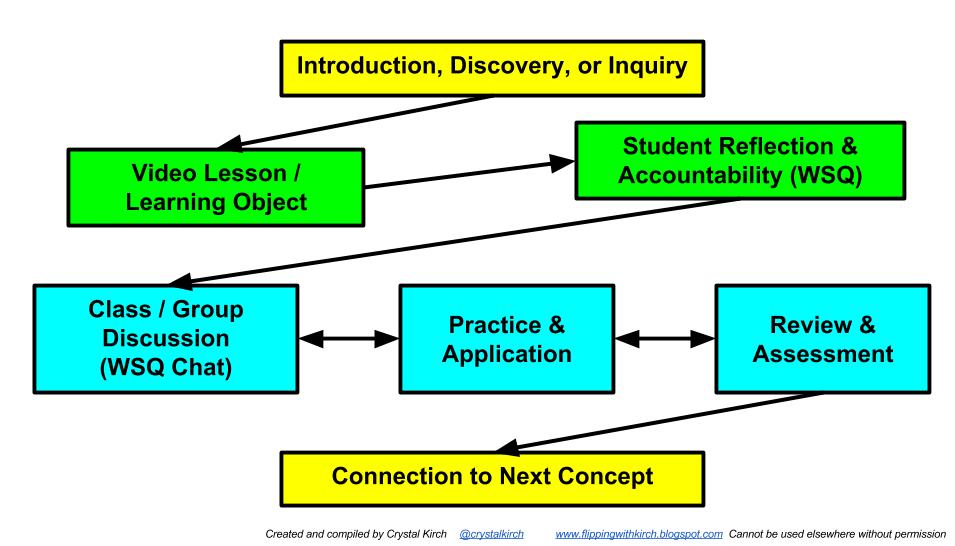
My current flipped learning lesson cycle looks like this:
You'll notice I have a piece at the beginning and end that place the video in an intentional spot in the learning cycle rather than always necessarily at the beginning. Also, acknowledge how concepts connect to one another and "telling the story" of your content is huge. You'll also notice the arrows for the turquoise part go in both directions, because not everything always goes in the the same order and the learning activities need to be placed purposefully. Lastly, the "Practice & Application" box looks exactly the same from the image above; however, the types of application activities students are involved in have improved and transformed.


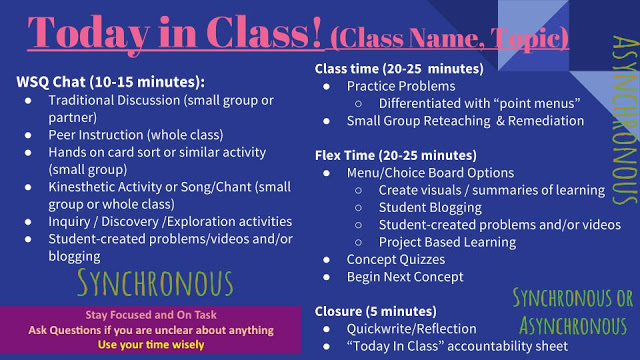
Here is a sample "Today In Class" Entry Screen that would be up every day once I went digital.  It's not specific to a lesson, but it bullet points different types of activities that may be on each section for a certain day (note: not all types of activities were on there for every day!!!)

Coming up in the next few weeks - Additional comments on this original post in relation to some more areas:

Part 3: Basic structure of in-class time (this post!)
Part 4: Facilitating your first WSQ chats


Purchase my new book today!  Click here for more details and to place an order!  Also on Amazon.com at bit.ly/fwkirch

Related Posts Plugin for WordPress, Blogger...