Showing posts with label flnhub. Show all posts

Saturday, July 29, 2017

How my #flipclass journey began #flipblogs


I tell this story at every training I give.  It was October of 2011, and I was trying something new in my Math Analysis classroom.  It was a strategy I had seen during walkthroughs of other math teachers' classrooms, and I thought it had great potential (and it does... I just didn't execute it greatly on my first attempt).  It was called "expert teacher" and the idea was that I would teach a small group of 8ish students the skill, and then they would go back and teach their small group of 2-3 classmates.  Then, I could walk around and support the groups, but not have to try to instruct all of them at one time.


The skill was how to use their graphing calculator to find relative maxima and minima.  The majority of my students left that day still confused because their "expert" did not explain it very well.  I felt rushed, frustrated, and disappointed, but my optimistic self told my students as they walked out the door, "Still make sure to try those homework problems, and we'll revisit this tomorrow."  As soon as they walked out the door, I knew I had to do something.  I had gotten a new Aver Document Camera at the beginning of the year that recorded videos straight to my mac, so I put the graphing calculator and some paper under the camera and recorded a quick video that explained the lesson. I posted it on Edmodo and sent it out to my students to watch "if they needed it."  

When my students came back the next day, I got really good feedback about how helpful the video was, and how easy it was to understand what they were supposed to learn the previous day.  Most of them said, "This was actually really easy."  I left that second day with thoughts beginning to form in my mind about what it would look like if my students had watched that video before coming in to the "expert teacher" lesson.  Would they have been able to get the differentiated support they needed?  Would I have been able to go deeper with the material and gotten to more application or analysis work?

I did some searching online (at the time I was not on Twitter) for "using video in the math classroom" and stumbled across the idea of something called a "flipped classroom".  It was in the middle of the first semester, but I proposed the idea to my students based on our experience with the "expert teacher" lesson, and they thought we should give it a try.  So, for a couple weeks, I had my students watch a video explaining the basics of the material for two or three of the lessons.  Then, when they came into class, they were able to work together and with me in small groups to apply their knowledge and do the practice.

I quickly realized it was a lot harder to "flip" a few lessons a week than to just be "flipping" every day.  There was too much confusion on expectations ("was today a video day or a regular day?"), so I jumped 100% in.  (I always tell people in trainings that at this point, I had no kids at home... I had more time on my hands and could do this.  Not that it's not doable with kids at home, but it is a lot of work...)

After another month, I proposed the idea to my Algebra 1 class as a "trial" - did they want to try what seemed to be working so well in my other class for just one unit?  They struggled with doing homework at home, and I knew a good percentage of the students struggled not because of motivation but because they would forget the content or needed support at home that they did not have.  I proposed it to them as a way to be able to get help with their homework during class time, and they jumped on board.

It's a long story, but why did I start?  Why was I inspired to flip my classroom, resulting in a completely new philosophy of teaching and learning?   I wanted to better support all my students, and I didn't feel like I was able to do that consistently or effectively. I wanted to be there to help them and challenge them when they needed it the most, and not just "teach to the middle".  I wanted class time to be more about them and less about me, where learning went beyond just being able to solve problems I had modeled for them.  I wanted them to have more opportunities to demonstrate TWIRLS (see #flipblogs post #1).  Flipping solved a problem that I had in a way that nothing else I had tried could. 

What problem does flipping solve for you?  If you don't have an answer, then why are you doing it?  
  • If it's because flipping sounds "cool" or "techy" or "modern", then please... STOP.  
  • If you think all it means is having students watch videos at home, then please... STOP (or just don't call that flipping).   
  • If you think it will save you time or make your life easier, then please... STOP.  
  • If you aren't willing to put the time into taking risks and trying new things, reflecting on what is and isn't working in your classroom (including gathering feedback from students), reaching out and collaborating with others to learn best practices and get new ideas, and refining what you are doing in your classroom, then please... STOP.

I realize I only answered the first question for this week's #flipblogs prompt, but I've gone on long enough.  (Unless you say my first step was sending videos home with my students. I guess it was.  But flipping truly became transformational once I developed the WSQ model and really started trying new things with my class time besides "work on these problems and I'll help you".)  

If you want to know more about what my first steps really were, then please check out my 2011-2012 weekly reflections, where you can really see week by week how I started and where I went starting in January of 2012.  I think it will be well worth your time. 

In addition, you can read more about what has worked for me in flipping my classroom in Flipping with Kirch: The Ups and Downs from Inside my Flipped Classroom.


Also on Amazon.com at bit.ly/fwkirch


Sunday, July 16, 2017

Taking learning to the next level through structures that allow for TWIRLS... #flipblogs

Design Credit: Matthew Moore
Credit: Andrew Swan
Introduction & Background
A random Twitter conversation between myself, Andrew Swan, and Matthew Moore led to the launch of a flipped learning chat modeled after good flipped learning practices.  You can read the goals and purposes in the image above.  I hope this encourages many of you to open up the walls of your classrooms by blogging about the prompts that will be posted to the #flipblogs hashtag.  Here is my attempt at going back in time to share a moment from my classroom.  If you'd like to read more, check out my weekly reflection posts (2011-2012, 2012-2013, 2013-2014) or my book, full of practical strategies, examples, and recommendations at bit.ly/FWKirchBook.  I hope to chat with many of you during the Twitter Chats on #flipblogs!

Credit: Andrew Swan

I was in my 5th year of teaching when I started flipping my class.  I remember having an unfulfilled desire every year: I wanted my students talking more and writing more in my math class.  I tried so many strategies that I learned about in different workshops, but I was not able to find a way to successfully and consistently provide opportunities for my students to talk and write to the extent that I desired.

One of my first posts when I started blogging back in 2012 was titled TWRLS, and briefly explains the transformation I began seeing in my students being able to show their thinking through writing, reading, listening, and speaking. (Note: Later I added and "I" in the middle for "Interacting" and it became TWIRLS.  Someone at a webinar I was hosting mentioned it in the chat and I loved it, so I added it!). 

It was so rewarding and gratifying to find a way where daily my students were taking their learning to the next level and expressing their learning to me (and their peers) in many more ways than just solving rote problems.

So, how did flipping my class allow my students to demonstrate TWIRLS (Thinking, Writing, Interacting, Reading, Listening, Speaking) effectively and consistently when I tried for so long with success?  I believe it can be pinpointed to 2 things, all that deal around structures that provided the time and space for students to do so.  If you've read my blog before, you know I am a fan of structures, because I feel like having consistent and clear structures help to set students up for success.  Here's a very brief overview of the structures I feel helped to make the transformation for my students.  For more info, check out the 4 part series I wrote in August of 2016 (Part 1, Part 2, Part 3, Part 4)

1. Pre-Class Structures
Students don't "Watch a Video", they complete a WSQ.  I'm going to just direct you to the 4-part series linked in the previous paragraph (Part 1Part 2Part 3Part 4) or to my book to learn more about how to utilize the WSQ method effectively.  Please ask questions in the comments and I'll clarify or direct you to a more specific place.

2. In-Class Structures
Class time transformed from having students be able to just work on practice problems and get individualized attention and support to a place where I was actually able to talk with every student every day (it's not just a coined phrase - it can actually happen!).  Because we started class with a WSQ Chat (see part 4 linked above) and then provided opportunities for students to process their learning and demonstrate their understanding through blogging (see more student blogging resources here), I began to see that it wasn't just me (the teacher) who could demonstrate TWIRLS in class.  It became my goal that my students were always the one demonstrating the most TWIRLS on a daily basis.

In my classroom...
I can't just pick one story to share in this post...so I decided to pull a video from the archives where my students share about their experience and how the flipped classroom helps them demonstrate TWIRLS in many ways.  It's 10 minutes long, but I think hugely valuable to give a window into my story.


Also on Amazon.com at bit.ly/fwkirch


Monday, August 29, 2016

Revisited: (Part 4 of 4) Using the WSQ to deepen student understanding and academic conversations in my Flipped Classroom

Over the next year, I'll be revisiting some of my favorite (and most popular) posts from the last (almost) 5 years of blogging.  I hope to add extra insight and reflection to these posts from my experiences both in my classroom and in training and coaching other teachers with flipped learning.  

If you are interested in learning more about the WSQ strategy, I recommend that you check out Flipping with Kirch: The Ups and Downs from Inside my Flipped Classroom.

The last post described a bit about class time structure.  This post in this series will delve a little deeper into what I called the “WSQ Chat”.  Check out my slide deck from “Winning WSQ Chats” (embedded below) for a visual journey, or scroll past the slide show for a quick overview of my 5 favorite types of WSQ chats.


Traditional group discussions is how I started my entire first year flipping.  Then I realized there were more ways for the students to "discuss" and have conversations about the material than simply giving them a time limit and prompts to talk about.  While this is still a valuable strategy, I would encourage using it in conjuction with several of the other strategies below.
I love discussion activities that also get students up on their feet and moving around.  Whether this be card sorts / card chains or having the students physically represent a concept to gauge their understanding, these type of WSQ chats are enjoyable, often competitive, yet lead to natural and deep academic conversation.
I became a huge fan of inquiry / discovery activities as I realized I had a little more time to do so with the flipped classroom!  I also shifted pedagogically to value student construction of ideas and inquiry instead of simply feeding them everything from the get go.  These WSQ chat activities are unique in that they fall in a different place in the flipped learning cycle (before the video) than normal WSQ chats.  They also require a lot of forethought on the part of the teacher in terms of what type of scaffolding the students will need and what probing questions will be asked throughout the activity.

Student blogging and creation became one of my favorite things that I could do after I flipped my classroom.  I found that if students had to write their own math problems, and then either record them on video or put it together neatly in a sequence of pictures, it really helped deepen their understanding of the concept and their ability to explain their thinking.  In addition, when their work is published to the world, it "ups the ante" a little bit in terms of quality and attention to detail.  Lastly, what a great opportunity for students to do some peer evaluation and critique on each other's blog posts and created work!

I learned about Peer Instruction at FlipCon one year (I think...) and instantly fell in love.  While I may do it slightly different than the "real" Peer Instruction, it's still such a valuable method for WSQ Chats.  It's a little different than the others in that it's much more teacher-guided, but it still allows for great discussion amongst students and leads to deeper understanding - which are the goals of WSQ chats!

There are 27 specific WSQ chat ideas in my book (bit.ly/FWKirchBook) and I'm sure more I can think of since it's been published.  Don't get locked in a box!  Students need and like variety to keep them engaged in purposeful discussion activities that will solidify and deepen their understanding of the material.  I’d love to hear how you use a “WSQ Chat” in your classroom - comment below and share!

Purchase my new book today!  Click here for more details and to place an order!  Also on Amazon.com at bit.ly/fwkirch

Wednesday, August 17, 2016

Revisited: (Part 3 of 4) Using the WSQ to deepen student understanding and academic conversations in my Flipped Classroom

Over the next year, I'll be revisiting some of my favorite (and most popular) posts from the last (almost) 5 years of blogging.  I hope to add extra insight and reflection to these posts from my experiences both in my classroom and in training and coaching other teachers with flipped learning.  Updated comments from the original post are changed to blue font.


If you are interested in learning more about the WSQ strategy, I recommend that you check out my book, Flipping with Kirch: The Ups and Downs from Inside my Flipped Classroom, which was released in May of 2016.

~Original Post Below~
Updated comments from the original post are changed to blue font.

Class time… that’s the big question.  How do you make a flipped classroom more than just “videos and worksheets”?  I did a webinar last night (feel free to check out the archive here) and I think the easiest, yet broadest, answer to that question is: Design your classroom so students are doing more than just worksheets! And of course, the question is, “What do they do then?”  And, my answer would be, “What do you want your students doing more of?  What would be the ‘something better’ that you could do?”  I know, not what people want to hear who want a cookie cutter answer.  I can provide ideas of what I did in my class, but that’s not going to be the answer for everybody.

A “flipped classroom” (and that’s in quotes because I don’t think these are really flipped classrooms) can have students just coming in and doing worksheets. But if you begin to answer the question, “What’s the best use of my face to face time?” and “What do I want students doing more of during class time?”, you can truly start the transformation.  Flipping (removing direct instruction or teacher-centered / teacher-focused activities outside of the group learning space) gives you the ability and the freedom to rethink what class time looks like.

I wanted my students talking more - demonstrating TWIRLS (Thinking, Writing, Interacting, Reading, Listening, Speaking).  That was one of my goals.  So, I designed activities around that - the WSQ (in Part 3 of my book), WSQ Chats (in Part 4 of my book), Student Blogging (in Part 5 of my book), etc.  These activities were only possible because I freed up more class time for more student-centered activities rather than teacher-centered.

I also wanted my students to have more individualized support and attention during class time.  So, I made sure that I was always walking around, checking in with every group and hopefully every single student individually every single day.  I set up my classroom so there was a small group area for me to remediate and reteach “just in time” when needed.  This was only possible because I wasn’t “wasting” class time delivering direct instruction or guiding activities whole-class most days.

What are your wants?

Do you want your students creating more? Presenting more? Designing? Debating? Writing? Explaining? Collaborating?

Think through a class period and analyze all the pieces you could REMOVE and place online / outside of class time.  And, you’ll have a lot more time to do what you really want!

The "Incomplete" Flipped Learning Lesson Cycle
Ok, so you want some practicalities?  Here’s what my class time looked like when I first started flipping - just a couple months in.  All I really added to the “Video” and “Worksheet” was the WSQ and WSQ Chat - but that made a huge difference in accomplishing my goals at the time!


IN CLASS TIME?
I am still trying to come up with different "activities" to vary the in-class time.  This takes time and that’s ok.  I mean, it could take a couple years.  But, focus on constantly reflecting and improving upon what you currently have - that’s all anyone can ask for.   My Algebra 1 class is definitely much more structured, while I am slowly letting my Math Analysis class have more freedom and take full control of their pacing and learning.  Here's what a sample day may look like:

Algebra 1:
  1. Students come in and get out their WSQ's (kept in a spiral notebook), SSS packets (see FAQ page for details on these guided notes packets), and WSQ sign-off charts. *Students who have not watched the video must tell me before the tardy bell rings and they start watching it on a classroom computer.  I usually only have about 4-5 kids who don't watch it, however I have had bad days where 10-11 don't watch it (I have 36-38 students per class).
  2. We generally do a quick 1-2 minute review of the important pieces of the video, and if a student has a dire question they want to ask to the whole class, we go over it. Watching your time on this portion of class is key.
  3. Students get in their WSQ groups and do one of the WSQing methods I am developing.  All WSQing methods require that students get a written answer to their question.  This WSQing time is an opportunity for students to do 3 things: (1) Process & digest the content collaboratively in a low-risk environment; (2) participate in a structured activity where they can demonstrate TWIRLS; (3) provide the teacher with a “window into their thinking” as they participate in the activity and the teacher listens in, probes, ask questions, etc.  There are lots and lots of WSQing ideas for the "WSQ chat" portion of class can be found in my new book at bit.ly/FWKirchBook.
  4. While students are WSQing, I am walking around, listening in, commenting, and probing with deeper questions.  This process takes 10-15 minutes, depending on the concept and on the group's ability to stay on task. Again, a timer here is important. It helps keep the students on track and makes sure that they have time to move on to the practice / application portion of class.  Sometimes it may only be 5 minutes.  I want to emphasize that the teacher's role during this time is huge. You must be walking around and probing the groups!  Not only does this keep them on task, it gives you another window into their thinking and helps you to identify common misconceptions that may require a different explanation or clarification.
  5. Students get to work on the assigned practice problems for the remainder of the period (30-45 minutes).  I walk around and sign off on their WSQ charts.  I do not sign off on the summary if it is not complete (at least 5 sentences), and I do not sign off on the question if it is not answered.  At this time, students are allowed to work with people outside of their WSQ group and possibly move seats to work with a different group. Some years I signed off WSQ charts, some years I didn't. Depends on the level of students and their work ethic / motivation.
  6. If students finish the assignment early, they may start watching the new video for that night.
  7. For each concept, students must take a concept quiz.  This is a day or two after they have learned the concept.  Right now, the whole class takes the quiz on the same day at the same time, usually after the WSQ and before the practice problems.  I am hoping to modify this as my students get more used to the process (like I am currently doing in my Math Analysis classes)

Math Analysis:
  1. Students come in and get out their WSQ's (kept in a spiral notebook), SSS packets, and WSQ sign-off charts. *Students who have not watched the video must tell me before the tardy bell rings and they start watching it on a classroom computer. I generally only have 1-2 students a day not prepared.
  2. We generally do a quick 1-2 minute review of the important pieces of the video, and if a student has a dire question they want to ask to the whole class, we go over it.  Usually if a question is asked in Math Analysis, before giving the answer, I ask the groups to discuss the answer and then have one of them share out.  That way, they are still doing the thinking and I can just guide, support, and follow-up.
  3. I go over the goals for the day, posted on a "Task List" on one of my standing whiteboards.  This includes everything the students need to try to get done, reminders about anything that needs to be turned in, etc.  Then I let them loose to work.  I try to give them more freedom than my Algebra 1's and they generally do very well with it. The "task list" evolved into a Digital Task List.  I so wish I had kept this on a running Google Slides so I would be able to share a whole years worth. Unfortunately, there were days I would show up to work and Google would be blocked.  So, I had to do it on PowerPoint. And I didn't back it up anywhere. Argh :(
  4. The WSQing process for Math Analysis is a little less structured.  My expectations for them are that they discuss their summaries in their groups and get their question answered somehow.  Some days I may give them more specific directions (today I want you to have all your math vocabulary highlighted and/or defined; today I want you to develop one "perfect" summary from your group before you get started on the problems, today I want you to pick your groups "Hottest" question and post it on the whiteboard, etc).  Much of this is done on a more small group basis rather than as a whole class. We needed a greater variety of methods for this time in class... this got old fairly quickly.  I reflected on that here. There are lots and lots of WSQing ideas for the "WSQ chat" portion of class can be found in my new book at bit.ly/FWKirchBook.
  5. Students get to work on their Task List for the day.  This includes practice problems, concept quizzes, and videos.  Some students may need to watch or re-watch a video.  Some students just need to practice a few problems and then they are ready for the quiz.  Some students need to spend the whole period practicing the problems.  I have started to let them have more and more freedom to self-monitor and self-assess.  While I have a few students work ahead, most students are still on pace with the daily expectations.  My quote was “You can work ahead, but you can’t fall behind”.  Activities continued to evolve for this time of class.  I became a huge fan of student creation and student blogging (see samples here) as well as adding inquiry / discovery activities before the video or after a simple introduction video.
  6. I walk around and listen, probe, question, and correct while signing off their WSQ charts for the day.  If I feel the need to go over something as a whole class because I am noticing common misconceptions, or if I want to do a quick check of understanding and have every group solve a problem and show me the answer (like on a group whiteboard or something), that can happen.  It all depends on what I am seeing from the students.

I'm leaving this original post intact, since that is the purpose of "revisiting" it.  However, class time definitely evolved to have some more structure yet variety in the activities that students participated in.  You can't change everything in your class all at once, nor can you do so in your first year flipping.  Every year I flipped I continued to modify and add to the different activities for different concepts, as I found methods that I liked and that worked for my students' learning.

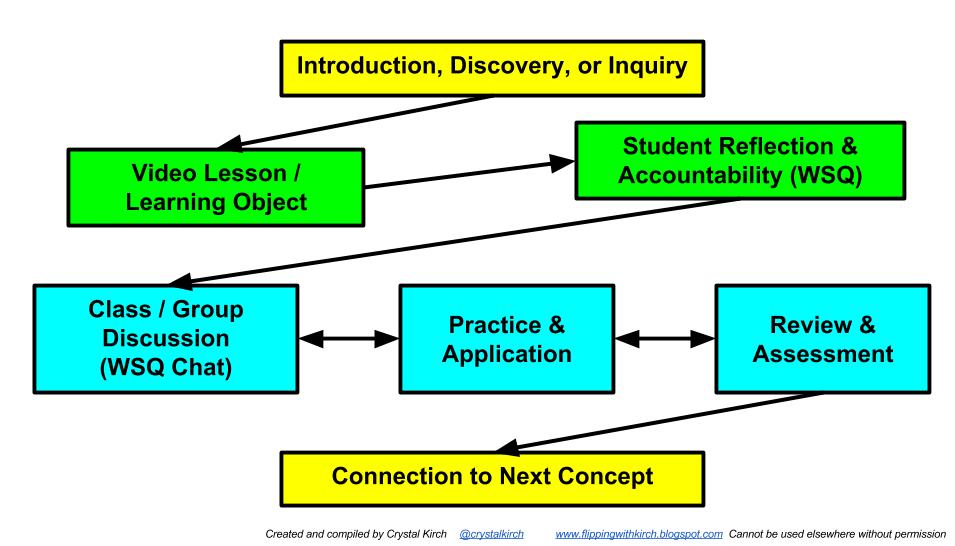
My current flipped learning lesson cycle looks like this:
You'll notice I have a piece at the beginning and end that place the video in an intentional spot in the learning cycle rather than always necessarily at the beginning. Also, acknowledge how concepts connect to one another and "telling the story" of your content is huge. You'll also notice the arrows for the turquoise part go in both directions, because not everything always goes in the the same order and the learning activities need to be placed purposefully. Lastly, the "Practice & Application" box looks exactly the same from the image above; however, the types of application activities students are involved in have improved and transformed.


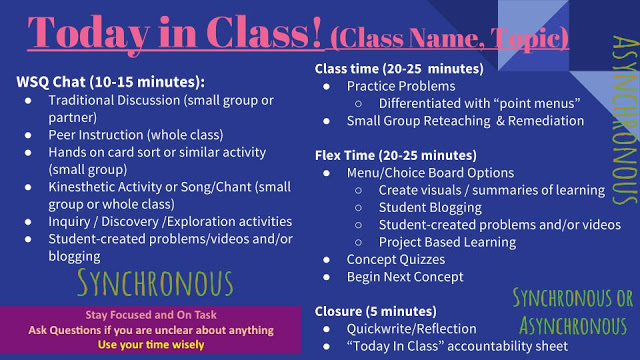
Here is a sample "Today In Class" Entry Screen that would be up every day once I went digital.  It's not specific to a lesson, but it bullet points different types of activities that may be on each section for a certain day (note: not all types of activities were on there for every day!!!)

Coming up in the next few weeks - Additional comments on this original post in relation to some more areas:

Part 3: Basic structure of in-class time (this post!)
Part 4: Facilitating your first WSQ chats


Purchase my new book today!  Click here for more details and to place an order!  Also on Amazon.com at bit.ly/fwkirch

Thursday, August 11, 2016

Revisited: (Part 2 of 4) Using the WSQ to deepen student understanding and academic conversations in my Flipped Classroom

Over the next year, I'll be revisiting some of my favorite (and most popular) posts from the last (almost) 5 years of blogging.  I hope to add extra insight and reflection to these posts from my experiences both in my classroom and in training and coaching other teachers with flipped learning.  Updated comments from the original post are changed to blue font.


If you are interested in learning more about the WSQ strategy, I recommend that you check out my book, Flipping with Kirch: The Ups and Downs from Inside my Flipped Classroom, which was released in May of 2016.

~Original Post Below~

Updated comments from the original post are changed to blue font.


So, what is the WSQ model?  This post will describe for you the three parts: Watch, Summarize, Question.  Hopefully my insights will give you specific ideas of how it played out in my classroom.  But, remember, every classroom is different and I’m sure you will need to tweak the way I did things to make it work great for you.

I describe the WSQ for teachers as a model for how students can interact with and process video content in order to facilitate effectively structured class time and engaging student-centered learning activities.


WATCH
  • All students are required to watch the videos on a nightly basis and take notes in their SSS notes packets that correspond to what I am writing on in the videos. I check to see that students have written down the important information I talked about the video; highlighted key information, and worked out the few problems I instructed them to try on their own before class. You can read more about my SSS packets on my FAQ page. I can’t post them publicly since they include copyrighted problems from Kuta software.  If you’d like to see a copy without the sample problems, just email me to request one.  It is usually evident to me who actually watched the video and who just "watched" or didn't watch at all. As I mentioned in my last "Revisited" post about the WSQ, I don't set aside class time checking their notes, but this happens throughout the class period as I have conversations with the students.  They know it can be checked at any time. Remember, I always wanted to make the best use of my class time, and designating time for me to be walking around checking notes while students weren’t actively engaged in something else is what I consider a waste of time!
  • Students usually have 4-5 videos a week.  The only time they generally bring home "regular" practice homework is on the night before a Unit Test.  I have chosen to keep it this way to maintain consistency.  At the beginning of the year when I was just testing the waters, we would flip one lesson but not the other and the students (and myself) got confused on if they were supposed to watch a video or do regular homework.  I like having consistency.  However, I still have the opportunity to teach or preview a lesson before students watch the video if I see fit. I still encourage consistency, and if it's not a video all the time, I recommend having your assignment chart planned out for the whole unit in advance so students know what their next assignment is.  The bad part about having them watch a video for one lesson and not another is that it really locks all students into learning at the same pace.  While the majority of my students were always +/- 1 to 2 days from the "on pace" schedule, it was nice that they had some freedom to learn at their own pace and if they ever missed class they didn't fall super behind.  Also, the number of videos per week really depends on your grade level and subject.  In my Math Analysis class, we learned new content every day - it was a fast-paced honors course.  That is a lot different than my CP Algebra 1 class, which usually would spend 2 days on a concept, or from a non-math class where the videos cover material that could be discussed over the course of a week or weeks.
  • Videos range from 8-15 minutes long.  I try to keep them short and cut them into Parts if they extend past 10 minutes. 1-1.5 minutes per grade level is my current recommendation (from Jon Bergmann).  I recommend chunks of 5-7 minutes max if you can.
  • Most videos include a "Part 1" - theory, instructions, vocabulary, introductory examples as well as a "Part 2" (and even sometimes "Part 3" or "Part 4" of additional examples for students to view).  I still recommend something similar to this.
  • If we spend more than one day on a concept, students will still watch a video each night.  The first night will be more introductory, and then after we work on the concept in class, they will watch a second video that is a little more advanced. I still recommend something like this.  The hard part of not doing it this way is you will have students who need that collaborative class time before approaching any of the more "advanced topics", so watching everything in Night 1 is unproductive.  Or, you will have some students who watch NOTHING the first night, and come to class on the first day with zero background knowledge or content basics.  They then have to watch the videos in class and miss out on the collaborative discussions and activities.
  • Students may work ahead and watch videos ahead of schedule if needed or desired.  Students may watch videos in class if they choose, and work on practice at home.  This is not suggested, but is an option available. "You can work ahead but you can't fall behind" became my mantra.
  • Students are encouraged to rewind and rewatch videos, and also to pause and try examples on their own before watching me work through it or checking their work compared to mine (see "The Power of FFW" - a great post by a colleague at flippingmath.  I always try to have an example or two that I specifically ask the students to pause and try on their own, or leave a few examples for them to try at the end of the video on their own before class (of which they can watch me work out in "Part 2" of the video).  I am starting to encourage students to take initiative and try problems on their own in the video before they watch me try them.
  • See my video library on my YouTube channel. Videos are also available on SchoolTube under the same titles as the YouTube videos (you just have to search for them by name).  My YouTube channel is a mess. Sorry. I haven't had time to organize it.  You can find my videos at my class websites at kirchmathanalysis.blogspot.com and kirchalgebra1.blogspot.com.

SUMMARIZE
  • After watching the video, students write a summary of the important pieces of the video.
  • Summary must be a minimum of 5 sentences long, but most are much longer.  My lower-level Algebra 1 students struggle with writing complete and detailed summaries.  Students are given sentence starters to help them in writing a minimum of five sentences. By the end of this school year, the majority of the summaries consisted of "guiding questions" to help the students out.  You can have them write the summary still in paragraph form based on the 2-4 guiding questions, or you can simply have them answer the guiding questions.  If your students need more scaffolding, you can also provide sentence frames for them.
  • The purpose of having students write a summary is to try to put in their own words what they just saw and heard on the screen.  It is easy to copy notes and then say "oh yeah, I got this. That made sense."  It is a whole new level for them to watch the video and then have to condense the information into a comprehensible summary, using their own words.
  • I am pushing students to be using math vocabulary in their summaries.  In certain instances, I make them highlight all of the math vocabulary that is used in the summary (minimum of three words per summary).  I may even have them define those vocabulary words in their own phrasing in the "Answer" portion of their WSQ in class. I wish I kept up with this better, but I didn't.  Definitely something I would change to make it a consistent part of the "S" portion.
  • Students will complain about the summary, because it makes them think.  I like it :)

QUESTION
  • Students have to come up with a question about something from the video.  Sometimes this is a question about something they didn't quite get, but more often than not it is a question they have to come up with that (1) someone else might have or (2) is an important piece about the concept.
  • Questions cannot be answered with a simple yes/no.  Students will be asked to re-write their question if this is the case.  See the "Algebra 1" section of my Week 3 Reflection for some details on this.
  • All questions must have a written answer after them.  This is done in class in a variety of different ways.  Sometimes I have the students write the answers to their own questions and sometimes I have them trade notebooks and write the answer down in their partner's notebook.  Either way, students are given the opportunity to ask the question, discuss the question, and make sure to get the right answer.
  • I really try to push my students (mainly Math Analysis at this point) to as HOTter questions (Higher Order Thinking) that move up Bloom's Taxonomy from basic recall and understanding to application, analysis, synthesis, and evaluation.  They are getting better at it, but I still often see those very basic recall or comprehension questions.  When I see those, I ask them follow-up questions and probe deeper, and then have them write the answers to all of those follow-up questions as well.  With probing, we can turn most of their "non-HOT" questions into "HOTter" ones.
  • The question can be a confusion, clarification, discussion, or example question.  A couple of months after this post was written, I began having students submit their WSQs on a Google Form so I could actually see the questions before they came to class... such a valuable tool for me as a teacher!! You can do so much with the questions in class if you actually have them before the kids walk in!


The WSQ model seems like a simple concept - and it really is - but it was hugely transformative in my flipped classroom and allowed me to begin answering what I now call the “5 questions every flipped classroom teacher must answer” (see the five purposes image to the left).  There’s more that goes into answer these questions than just the WSQ (which will be coming in future posts this year), but it is the starting point and foundation.

See the one-page handout that I give to students at the beginning of the year here (embedded below).  You are welcome to use as long as attribution is given as follows:
“Modified with permission from Crystal Kirch at flippingwithkirch.blogspot.com”


Coming up in the next few weeks - Additional comments on this original post in relation to some more areas:

Part 2: Considerations for effectively utilizing the WSQ method (this post)
Part 3: Basic structure of in-class time
Part 4: Facilitating your first WSQ chats


Purchase my new book today!  Click here for more details and to place an order!  Also on Amazon.com at bit.ly/fwkirch

Related Posts Plugin for WordPress, Blogger...