-
129 Digital Citizenship Links on 22 Topics | Ask a Tech Teacher
-
Everything You Need To Know In Google Classroom (Part 1) | The Gooru
-
Problem-Solving for Teachers (Differentiated Coaching: Chapter 3) | Putting the Heat on S.T.E.M.
-
Using Math Mistakes in Whole-Group Discussions « Math Mistakes
-
Coaching fields forever #educoach #twistedpair | the édu flâneuse
- we need to be present, pay attention, and expertly use questioning to reveal those glossy, or rotten, unsurfaced thoughts which help that person to take their own reflection, practice or dilemma to the next level.
- So while a coach might apply a coaching conversation map or set of tools to all coachees, each relationship and each conversation will look different, shaped by its person, time and place.
-
Sunday, October 18, 2015
The best articles & resources I've found this week (weekly)


Sunday, October 11, 2015
Success of the Week: TeachMeet Beckman
I decided to run a mini TeachMeet at our staff meeting this last week. When I say "mini", I mean we had three 2-minute sessions of teachers sharing something awesome they do in their classes with technology followed by 1-minute of reflection and debriefing with colleagues. It was a "test" to see the reaction, and to see if it's a model we want to continue to use.
It. Was. Awesome.
The 3 teachers each made 2-3 slides under the headings of "What I do" and "Three Reasons Why It's Awesome".
I asked for feedback from the staff and got so much positive feedback both in person and via email. Here are just a few of their comments:
Teachmeet was a great way to see how others actually use technology and gives us ideas on how to use it ourselves in a non-threatening and non-committal manner.
The TeachMeet format is terrific. I kind of compare it to a verbal Twitter: short, meaningful, designed to make an impact. I suggest we have at least one or two of these two minute TeachMeet's every time we have a staff meeting (and, yes, that means that I will volunteer to present one myself at some point!)
That was so much fun today!
I encourage you to try out a mini-TeachMeet at your next Staff Meeting! We are doing another one this next week!
Framing Coaching Conversations around TPACK and a "Third Point"
I blogged over the summer about the "A Year of Coaching" from a big picture viewpoint. This post will delve in a little deeper to what a coaching cycle looks like and what I've learned about asking the right questions to lead the conversation in a way that will allow for maximum reflection and growth.
 A coaching cycle, for me, consists of a pre-brief, implementation, and debrief. I always try to be there on the day of implementation, but it doesn't always happen. They usually last anywhere from 1-3 weeks depending on how much prep it requires and how far out we are planning.
It was pretty exciting when my team took another look at our district's "TUSD Connect" Focus, which is:

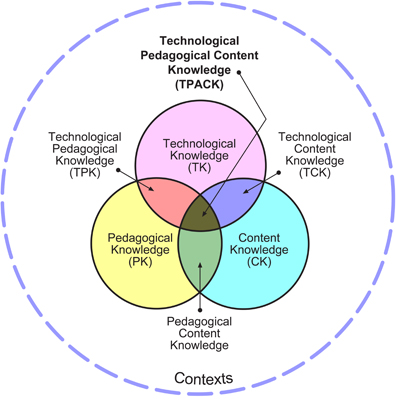
I worked a lot this summer on gathering good questions to help support each of these three parts of TPACK... how can I guide a teacher through the reflective process in planning, implementing, and debriefing through the lens of content, pedagogy, and technology? You are welcome to view my template of questions (which is still a work in progress) by clicking here.
[Please note that my questions have been accumulated from all over - web searches, in person conversations, etc... I can't take the credit for most of them :) However, having them organized within the frame of TPACK has really made them more useful for me.]
 A coaching cycle, for me, consists of a pre-brief, implementation, and debrief. I always try to be there on the day of implementation, but it doesn't always happen. They usually last anywhere from 1-3 weeks depending on how much prep it requires and how far out we are planning.
 |
| https://upload.wikimedia.org/wikipedia/commons/5/5f/Tpack.jpg |
I have become a fan of the TPACK model as a way to frame my conversations with teachers in a way that allows us to focus on good instruction first, supported by technology. I call the center part where all three overlap as the "sweet spot" - we want to make sure that we are considering all three aspects when going through a coaching cycle... and just because I'm a "Digital Learning Coach" doesn't mean we start with the Technological side first ;)
It was pretty exciting when my team took another look at our district's "TUSD Connect" Focus, which is:

We realized that TUSD Connect and TPACK go hand in hand! Our district's vision aligns almost exactly with the TPACK model. Now TPACK isn't just something "new" to talk about with teachers, it's just another way to support the conversation that has been happening for the last several years at our district.
I worked a lot this summer on gathering good questions to help support each of these three parts of TPACK... how can I guide a teacher through the reflective process in planning, implementing, and debriefing through the lens of content, pedagogy, and technology? You are welcome to view my template of questions (which is still a work in progress) by clicking here.
[Please note that my questions have been accumulated from all over - web searches, in person conversations, etc... I can't take the credit for most of them :) However, having them organized within the frame of TPACK has really made them more useful for me.]
Category
|
Pre-Brief (Date: ______)
|
Debrief (Date: ______)
|
Content Knowledge: What content / standard are you teaching?
| ||
Pedagogical Knowledge: How will you engage your students in learning? What are you trying to do?
| ||
Technological Knowledge: What tools will allow you to accomplish your goals?
| ||
Reflective Focus / Essential Question: What will be focusing on during the implementation / observation that we will reflect on before, during, and after the coaching cycle?
|
I have found that having a reflective focus helps to serve as the "third point" in conversations because it is something the fellow chooses and it's centered around a content, pedagogical, and/or technological goal. It allows us to look to that as our measure of "success" and helps build the capacity of the fellows to begin reflecting throughout the entire journey.
It's important to mention that a coaching conversation does not go through ALL of the sample question stems. However, having a "toolbelt" of good questions to ask helps me to guide the conversation and ensure deeper reflection. While I can't generally plan ahead for the questions I want to ask for a pre-brief, I will look through the debrief questions and pick out some specifically to talk through in our post-implementation conversation.
How do you structure your coaching conversations? Do you have question stems and starters that you use to help guide the conversation? Do you utilize a model like TPACK or something else?
This post is a part of Kathy Perret’s #EduCoach Blog Challenge. You can read more about it here.
Sunday, September 20, 2015
Saturday, September 19, 2015
Book Notes & Reflections: The Art of Coaching (Chapter 4: What Must a Coach Know?)
I've never blogged my notes and thoughts through a book, but I figure there's never a better time than NOW!
My goal is to create a reference & reflective place for me as I continue growing as a coach.
See my notes from all book chapters on my Coaching Page.
Direct quotes from the book are in blue. The nature of this chapter led me to taking a lot of direct notes from the book, so the bulleted lists below consist of a lot of content straight from or summarized from the book.
The goal of this chapter is to introduce us to "Coaching Lenses", because "when we're not working from a sound theoretical basis, we're just throwing strands of spaghetti on the wall to see if they stick" (page 45). Coaching lenses are valuable because we "can look at the same thing through different lenses and construct very different interpretations of the same reality" (page 49).
"The purpose of my coaching is not to impose a belief system, but ot help my coachee explore his beliefs and actions." (page 62)
The six lenses are:
1. Inquiry
2. Change Management
3. Systems thinking
4. Adult Learning
5. Systemic oppression
6. Emotional intelligence
Here are some of my key notes from 5 of the 6 lenses above (not Systemic Oppression)
Inquiry:
...Until Chapter 5...
My goal is to create a reference & reflective place for me as I continue growing as a coach.
See my notes from all book chapters on my Coaching Page.
Direct quotes from the book are in blue. The nature of this chapter led me to taking a lot of direct notes from the book, so the bulleted lists below consist of a lot of content straight from or summarized from the book.
The goal of this chapter is to introduce us to "Coaching Lenses", because "when we're not working from a sound theoretical basis, we're just throwing strands of spaghetti on the wall to see if they stick" (page 45). Coaching lenses are valuable because we "can look at the same thing through different lenses and construct very different interpretations of the same reality" (page 49).
"The purpose of my coaching is not to impose a belief system, but ot help my coachee explore his beliefs and actions." (page 62)
 |
| Source: https://upload.wikimedia.org/wikipedia/commons/9 /9b/Photographic_lenses_front_view.jpg |
The six lenses are:
1. Inquiry
2. Change Management
3. Systems thinking
4. Adult Learning
5. Systemic oppression
6. Emotional intelligence
Here are some of my key notes from 5 of the 6 lenses above (not Systemic Oppression)
Inquiry:
- values questions as much as the answers that are found
- understands that there is more to the picture than what we initially see
- we must think about the way we pose questions, because that will determine the nature of the answer
- we want others to create their own knowledge and their own solutions
Change Management:
- pushes us to consider how change might be made
- reminds us that beneficial change is possible
- understands that change cannot be made unless the following are present: incentives, resources, vision, clear action plan
- we must consider a person's will, skill, knowledge, and capacity to change
Systems Thinking:
- Understands that everything is connected
- To understand how the whole system works, we must look at the pieces, the whole, and the interactions
Adult Learning:
- There are many more starting points with adults and sometimes more things to "undo"
- We must understand the previous experiences, knowledge, competencies, beliefs, and interests that the learner is bringing to the new space
- We must accept that people can only be where they currently are
- Adults want control over the what, who, how, why, and where of our learning
- Adults must:
- see relevance
- have some say
- have direct, concrete ways to apply what they've learned
- need to feel emotionally safe in order to learn
Emotional Intelligence:
- Will help us to tune in to an individual's ability or skill to identify, assess, and control the emotions of oneself, others, and of groups.
In my work, I can see using the lens of inquiry, adult learning, and emotional intelligence consistently, and the other two when looking at things from a broader scope. I've mentioned several times before that my goal this year is to become a better questioner and prober, so using the lens of inquiry will help me focus on that. The lens of adult learning and emotional intelligence is foundational to the relational and trust piece that must be there for coaching to be successful. It's not just something you use at the beginning of the year though, and I must remember to continually look through things with those lenses throughout the year.
~~~
A frame used in the vignette example was "first I'd like to hear about how you experienced today." This is valuable to me because sometimes teachers will want right away for my perspective on a lesson, or sometimes I jump in too soon to offer my insight. If my goal as a coach is to help my fellows explore and reflect themselves, then I need to take the time to let them talk through how they experienced the different lessons and just probe them on.
...Until Chapter 5...
My Life as a Digital Learning Coach - Week 3 Reflections (Year 2) - VERSO APP & DAN MEYER
See all my posts on Coaching on my Coaching Page


 On Thursday, I had the privilege of attending Dan Meyer's workshop that was hosted by a nearby district.
 2. Turn the math dial up slowly - this allows for ALL students to access the math. Start at stage 0: watch a video. All students can do this. Then Stage 1: Ask a question. Stage 2: What's your estimate? Stage 3: What info do you need? This gets students hooked and engaged and they haven't even done "real" math yet.
This was an abnormal week for me. Monday and Tuesday I was on my campus, but Wed-Fri I was out at two different trainings. Because of that, I met with 9 of my 11 fellows over the course of 2 days rather than 4.5 days. I'm really excited though, because with most of them we will be starting our first "coaching cycle" next week. Most of them are utilizing Google Classroom and feeling more comfortable & excited about the potential with it. I also feel like I've been able to communicate the "TPaCK" model of looking at technology implementation well, where it's not just sticking a tech tool in there, but really thinking about what they are teaching, what their goals are in teaching it, what they want to see students learning or doing, and THEN really plugging in the tool that will help accomplish those purposes.

The rest of this post will focus on what I learned in the trainings I attended:
Wed / Fri - Verso App
Thurs - Dan Meyer
On Wednesday and Friday, Phil Stubbs from Verso came out and trained all of our district's coaches for a pilot of the Verso Campus, which is a way to be able to see the data across sites, subject areas, or basically whatever type of "campus" you choose to set up. I was familiar with Verso from using it with a fellow a couple times last year (and I had met Phil at FlipCon14 in Pennsylvania), but it was really great to see the pedagogy behind it and understand its purpose so much more. Verso is definitely something I would have used in my flipped classroom, had I known about it before I left the classroom! (I say that about so many things...)
A few highlights of things that I really like about Verso:
- Verso is an app that really gives students a voice in your class.
- Students cannot view other respondent's answers until they post, which means the discussion posts are students' original thoughts. In addition, it gives students time to really think and construct their own ideas before reading their classmates' thoughts. Teachers can set this threshold to be up to 3 posts before seeing others'.
- Student responses are ANONYMOUS to other students. The teacher can toggle between teacher and student view (so you can display the results with no names, but also look at them on teacher end with names). This lowers the "fear" and really allows students to just be honest, open, and do their best work.
- Verso is not just a discussion board, but something that will take the level of learning from SURFACE to DEEP. If you look at the picture below, you can see that it starts off being unistructural (one student's idea) to multi-structural (lots of ideas from multiple students but they aren't really connected together) to relational (start seeing how the pieces fit together, students commenting and making connections on each other's posts) to extended abstract (can extend and apply ideas to new ideas)

 |
| P.Stubbs, Verso |
- The teacher can group student responses based on the learning activity need or purpose. This allows for that deeper discussion, connection-making, possible remediation or redirection, or whatever is needed in class.
- It's not “E-Learning”, but “C-Learning”. It's way too easy for teachers to say, “Oh, she’s the ‘e-learning’ person, that’s not for me”. They can’t really argue with the “C-Learning” goals…(critical thinking, creativity, collaboration, communication, character, citizenship)
- This isn't just a feedback tool. It's a feed up (where am I going? - ahead of the lesson, a signpost of what they will be learning), feed back (how am I doing? - authentic evidence of learning because it's the students' original thought) and feed forward (where to next? - providing feedback that moves learners forward)
- We want students to connect the dots in their learning, but "you can't connect the dots without first collecting dots". Verso helps students to collect the dots and begin connecting them, and then allows for even further and deeper connections as the teacher designs.
- A learning community is NOT about pursuit of individual learning goals,it's also about contributing TO the learning & knowledge base of colleagues & school. Verso is socializing the change- the collective might of sharing and working together. This is what Verso Campus allows.
If you haven't checked Verso out, I would highly recommend it. It's free to use; the data that helps to "socialize the change" is what Verso Campus is all about and that is the premium part.
Here are some more quotes from the day that I tweeted out:


 On Thursday, I had the privilege of attending Dan Meyer's workshop that was hosted by a nearby district.
Dan brought up three misconceptions that math teachers generally have about how to engage students in difficult mathematics. The misconceptions were:
1. For math to be interesting, it must be real-world
2. Math should be related to a career (job-world) - "when will I ever use this?"
3. You must design lessons around things that interest your students; not just real-world but their real-world; the "relatable world"
Instead of these three misconceptions, he argued that we should strive for these three things:
1. Start a fight - choose things that allow for "constructive controversy" where students are sharing guesses or given opinion-based questions that math can help to answer or clarify.
2. Turn the math dial up slowly - this allows for ALL students to access the math. Start at stage 0: watch a video. All students can do this. Then Stage 1: Ask a question. Stage 2: What's your estimate? Stage 3: What info do you need? This gets students hooked and engaged and they haven't even done "real" math yet.
*One strategy for how to do this is to "Delete the textbook". Take a problem (think those word problems or application problems with lots of text, a diagram with lots of numbers, and parts a-d of questions) from your textbook and delete the majority of the pieces around it, leaving students with an accessible image with little extra information where they can enter the problem more easily. You then add in the "deleted" pieces slowly, asking more interesting questions as you go. You want to start controversy and drive interest and start a conversation around the problem.
3. Create a headache - Dan's been blogging about this idea over the summer, and I've enjoyed his posts. If __________ is the aspirin, then what is the headache? I'll leave you to his blog to read his examples of this.
Tuesday, September 15, 2015
Book Notes & Reflections: The Art of Coaching (Chapter 3: Which beliefs help a coach be more effective?)
I've never blogged my notes and thoughts through a book, but I figure there's never a better time than NOW!
My goal is to create a reference & reflective place for me as I continue growing as a coach.
See my notes from all book chapters on my Coaching Page.
Direct quotes from the book are in blue.
Unmonitored beliefs... Aguilar references a conversation she had with one of her mentors, and the mentor said, "No one can learn from you if you think that they suck." (page 33) This is a belief that is unmonitored because you might not ever intentionally think it, but it will come across in your word choice, conversation style, body language, and patience level. I make it a priority to have a non-judgmental and non-evaluative relationship with my fellows - I am there to support and challenge them in their journey. However, it is a battle to keep out the judgmental feelings that come into my head sometimes. If we want to help our fellows understand their belief system, we must first understand our own and be aware of the beliefs that creep up - and then address them through the lens of our core values. There is an activity that Aguilar put together on Core Values here.
Aguilar shares her 10-point Transformational Coaching Manifesto that has belief statements that stem from her core values. There were a few points that really stuck out to me.

...Until Chapter 4...
My goal is to create a reference & reflective place for me as I continue growing as a coach.
See my notes from all book chapters on my Coaching Page.
Direct quotes from the book are in blue.
Unmonitored beliefs... Aguilar references a conversation she had with one of her mentors, and the mentor said, "No one can learn from you if you think that they suck." (page 33) This is a belief that is unmonitored because you might not ever intentionally think it, but it will come across in your word choice, conversation style, body language, and patience level. I make it a priority to have a non-judgmental and non-evaluative relationship with my fellows - I am there to support and challenge them in their journey. However, it is a battle to keep out the judgmental feelings that come into my head sometimes. If we want to help our fellows understand their belief system, we must first understand our own and be aware of the beliefs that creep up - and then address them through the lens of our core values. There is an activity that Aguilar put together on Core Values here.
Aguilar shares her 10-point Transformational Coaching Manifesto that has belief statements that stem from her core values. There were a few points that really stuck out to me.
- "Meet people where they are". We must "seek to understand why a client is where she is...don't make her wrong for being wherever she is - she's just there." With a core value of compassion, Aguilar we are able to meet people where they are, which is the "only place to start when trying to make meaningful change." (page 40). Every fellow relationship is completely unique, and it's going to do nobody any good to compare. Sometimes I feel like my fellows apologize for where they are at now and I just have to constantly remind them that no apology is necessary - this coaching is for them, for where they are at now, not where they "should be" or "are supposed to be" as they compare themselves to others. I also think this applies to pedagogical mindset. It's hard to work with others that have a drastically different pedagogical viewpoint than you, but I have to remind myself of where I once was and the time and reflective energy it took to get to where I am today. It takes time and everyone starts somewhere.
- "There is no coaching without trust". "It takes time to build, and once it has developed, it should not be taken for granted." (page 40) I can't overemphasize trust. Being at my school for the second year, I was able to build a foundation of trust with most of the teachers I work with this year. Because of that, getting started this year was much easier. However, I know that trust has to continue to be built throughout the year, and make sure to hold true to everything I have done to build that trust.
- We must "listen very carefully... explore what is possible given the language that a client uses...be mindful of every word that comes out of my mouth." (page 41) I am trying to be a better listener this year, because I want my coaching meetings to be more about the fellows and their thought processes / needs / desires / visions and less about mine. I need to improve on picking up on words or phrases (or just tone of voice / body language) that they use and learn the "right" way to respond to different cues. In addition, I am trying to be more intentional about the words and phrases I use, especially with starters like, "What I heard you say was..." or "It sounds like..." or others that can be seen in some of the samples here.
- We must "be fully present" in every coaching meeting. My time is about my fellow, not the 3 hours of meetings I've had before or the 3 hours to come :) I even think mentioning my crazy schedule should be off limits because I don't want them to feel like they are a burden to me or my life is "too crazy". I actually love being busy going from meeting to meeting more so than having too much time off. I like having a block of time on Mondays to prepare for my meetings that week, but then "off I go"!
- We must understand that "transformation takes time - an undefined amount of time" and that "working from a place of impatience and urgency won't result in a transformed system." It's about meeting them where they are and assisting them in "identifying and taking the step that comes next" for them - not for anyone else (page 41). Every fellow progresses at different rates. I saw some transform just over last school year. Others took baby steps but definitely aren't "there" yet (meaning self-sufficient and ready to continue to grow without my support needed). We can't put a time limit on growth, and I don't ever want my fellows to feel pressured that they have to reach a certain point in their growth by the end of the year. I am just happy that they are growing and learning.
- We must "avoid getting attached to the possible outcomes that arise" (page 42). We must remind ourselves that we "don't [always] know what is right" because there are so many different possibilities of things that could happen. This is hard for me sometimes because I have a vision of how it would work in my classroom with my teaching style and my expectations. However, it's not my classroom - it's theirs. And they will do things differently and have different goals and methods than I would. We set goals together, but it's goals they want to set and outcomes they want to see. This is a challenge, but I can definitely improve in this area this year.
Once we know our core values, then we can develop our belief statements, which translate into actions we take. For example, "If one of your core values is appreciation, then a corresponding belief statement might be 'Always acknowledge the positive', which could guide your actions in a coaching conversation." (page 43). I need to do more reflection on what my core values are and develop a "manifesto" similar to Aguilar's.

...Until Chapter 4...
Monday, September 14, 2015
Book Notes & Reflections: The Art of Coaching (Chapter 2: What is Coaching?)
I've never blogged my notes and thoughts through a book, but I figure there's never a better time than NOW!
My goal is to create a reference & reflective place for me as I continue growing as a coach.
See my notes from all book chapters on my Coaching Page.
Direct quotes from the book are in blue.
Elena Aguilar starts this chapter by describing a coach "who didn't know what she was" (page 18). I felt a lot of that last year as I was getting started, but now I have a much clearer view of my role. Because of that, I can explain it better to others and get fewer of the "IT"-type requests that would come my way last year. It's far from "there" yet, but the first step is in being clear with myself why I am there - and then communicating that with the teachers on campus.
There are four things that Aguilar says coaching is NOT: (page 19)
1. A way to enforce a program
2. A tool for fixing people
3. Therapy
4. Consulting
I have seen all of these in one light or another and have had to combat them. I can't force teachers to use the new math units, but I can support them in their process of doing so. I can't force teachers to learn and coming across as someone trying to "fix" them is only going to damage any level of trust or relationship that was built. I need to make sure that the focus is on "learning and developing new skills and capacities" (page 20), not on counseling a teacher through issues of their past. Lastly, I need to remember that I am not an "expert" coming in to "train" others; rather, I am there to help "build [the] capacity of others by facilitating their learning". (page 20)
~~~
Aguilar describes three models of coaching: Directive, Facilitative, and Transformational.
The art of coaching is not just about what coaches do, it's also about what coaches think, believe, and their way of being. Because of that, we must approach our coaching as not just helping teachers change what they do, but also how our fellows think, believe, and their way of being.
Directive Coaching - focuses on changing behaviors
Facilitative Coaching - focuses on developing ways of being or exploring beliefs that will in turn change behaviors
Transformational Coaching - a process that explores behaviors, beliefs, and ways of being of both individual clients and the coach herself, as well as institutional systemic transformation.
What coaching model / stance should we take? It depends on the situation.
"Directive coaching strategies are relevant and necessary at times...[they] are also limited...Less likely to result in long-term changes of practice or internalization of learning...[does] not generally expand the teacher's internal capacity to reflect, make decisions, or explore her ways of being." (page 22) As I reflect on last year, there were definitely teachers I worked with that I took this stance more often than not (sometimes they indirectly asked for it and I didn't have the skills to redirect them to a more reflective stance, other times I think I just got impatient and found it "easier" to take this stance. However, long-term growth doesn't happen when I stay in that stance! I have seen it, and I need to work to improve this.
"Facilitative coaching supports clients to learn new ways of thinking and being through reflection, analysis, observation, and experimentation... Coach does not share expert knowledge... [Coach] builds on existing skills, knowledge, and beliefs and helps the client to construct new skills, knowledge, and beliefs that will form the basis for future actions." (page 23) When a fellow reflects and constructs their own knowledge and beliefs, there is deeper ownership of it and it's more likely there will be long-term change. If there isn't that "buy-in" that is created when the fellow feels like they are the ones in the driver's seat, they may not continue on with any of the changes implemented beyond the coaching relationship. Facilitative coaching seems to be a type of cognitive and inquiry-based coaching.
Aguilar gives a great summary of the Zone of Proximal Development (ZPD) theory by Vygotzky. She says, "The ZPD is the difference between what a learn can do without help and what he can do with help...a learner's ZPD is constantly shifting...When a learner is in the ZPD, [with the] appropriate assistance and tools - the scaffolding - then he can accomplish the skill." (page 23) Every teacher I work with has a different ZPD and part of my job is identify the type and amount of scaffolding they need
Transformational Coaching is directed so "the impact we have on an individual will reverberate on other levels." (page 25) In addition, it's not a one-way street. It's "not something we do to another... It is a complex dynamic engaged in by both client and coach." (page 29)
The rest of the book I'm sure will go into this in more detail. :)
...Until Chapter 3...
My goal is to create a reference & reflective place for me as I continue growing as a coach.
See my notes from all book chapters on my Coaching Page.
Elena Aguilar starts this chapter by describing a coach "who didn't know what she was" (page 18). I felt a lot of that last year as I was getting started, but now I have a much clearer view of my role. Because of that, I can explain it better to others and get fewer of the "IT"-type requests that would come my way last year. It's far from "there" yet, but the first step is in being clear with myself why I am there - and then communicating that with the teachers on campus.
There are four things that Aguilar says coaching is NOT: (page 19)
1. A way to enforce a program
2. A tool for fixing people
3. Therapy
4. Consulting
I have seen all of these in one light or another and have had to combat them. I can't force teachers to use the new math units, but I can support them in their process of doing so. I can't force teachers to learn and coming across as someone trying to "fix" them is only going to damage any level of trust or relationship that was built. I need to make sure that the focus is on "learning and developing new skills and capacities" (page 20), not on counseling a teacher through issues of their past. Lastly, I need to remember that I am not an "expert" coming in to "train" others; rather, I am there to help "build [the] capacity of others by facilitating their learning". (page 20)
~~~
Aguilar describes three models of coaching: Directive, Facilitative, and Transformational.
The art of coaching is not just about what coaches do, it's also about what coaches think, believe, and their way of being. Because of that, we must approach our coaching as not just helping teachers change what they do, but also how our fellows think, believe, and their way of being.
Directive Coaching - focuses on changing behaviors
Facilitative Coaching - focuses on developing ways of being or exploring beliefs that will in turn change behaviors
Transformational Coaching - a process that explores behaviors, beliefs, and ways of being of both individual clients and the coach herself, as well as institutional systemic transformation.
What coaching model / stance should we take? It depends on the situation.
"Directive coaching strategies are relevant and necessary at times...[they] are also limited...Less likely to result in long-term changes of practice or internalization of learning...[does] not generally expand the teacher's internal capacity to reflect, make decisions, or explore her ways of being." (page 22) As I reflect on last year, there were definitely teachers I worked with that I took this stance more often than not (sometimes they indirectly asked for it and I didn't have the skills to redirect them to a more reflective stance, other times I think I just got impatient and found it "easier" to take this stance. However, long-term growth doesn't happen when I stay in that stance! I have seen it, and I need to work to improve this.
"Facilitative coaching supports clients to learn new ways of thinking and being through reflection, analysis, observation, and experimentation... Coach does not share expert knowledge... [Coach] builds on existing skills, knowledge, and beliefs and helps the client to construct new skills, knowledge, and beliefs that will form the basis for future actions." (page 23) When a fellow reflects and constructs their own knowledge and beliefs, there is deeper ownership of it and it's more likely there will be long-term change. If there isn't that "buy-in" that is created when the fellow feels like they are the ones in the driver's seat, they may not continue on with any of the changes implemented beyond the coaching relationship. Facilitative coaching seems to be a type of cognitive and inquiry-based coaching.
Aguilar gives a great summary of the Zone of Proximal Development (ZPD) theory by Vygotzky. She says, "The ZPD is the difference between what a learn can do without help and what he can do with help...a learner's ZPD is constantly shifting...When a learner is in the ZPD, [with the] appropriate assistance and tools - the scaffolding - then he can accomplish the skill." (page 23) Every teacher I work with has a different ZPD and part of my job is identify the type and amount of scaffolding they need
Transformational Coaching is directed so "the impact we have on an individual will reverberate on other levels." (page 25) In addition, it's not a one-way street. It's "not something we do to another... It is a complex dynamic engaged in by both client and coach." (page 29)
The rest of the book I'm sure will go into this in more detail. :)
...Until Chapter 3...
Sunday, September 13, 2015
The best articles & resources I've found this week (weekly)
-
- 1. Writing requires reflection and greater understanding.
- 2. Blogging begins the cycle of collaboration.
- 3. Blogging allows the writer a chance to have a digital home.
- 5. Blogging encourages students to do the same.
-
-
- Because I have so much going on in my head
- Because I would like to go back to what was in my head
- Because I have something important to share
- Because everything I have to share is important
- Because “Why not?”
-
-
Wow.. this is what I've been asking myself for the last year! So great to see someone else's very clearly outlined ideas.
-
more twitter training stuff
-
more twitter training stuff
-
Great guide to use with teachers this year who are getting started w/ twitter.
-
better math conceptual development...
Saturday, September 12, 2015
Book Notes & Reflections: The Art of Coaching (Chapter 1: How Can Coaching Transform Schools?)
I've never blogged my notes and thoughts through a book, but I figure there's never a better time than NOW!
My goal is to create a reference & reflective place for me as I continue growing as a coach.
See my notes from all book chapters on my Coaching Page.
Direct quotes from the book are in blue.
What is a coaching stance? It is one that "views teachers, principals, and all the adults who work in schools as capable of changing practices". (page 5) As a coach, I have to believe that people can learn and change - otherwise, why am I even coaching? Secondly, I also have to have a "big picture" viewpoint of how the school's history and the "larger systems" impact my coaching work. I have definitely noticed this shift over the last year working as a coach. I see a lot more of the big picture and all of the moving parts that go into the work that schools and districts do. Part of this increased awareness (I won't quite say "understanding" yet) is because of my experience in my administrative credential program as well. As a classroom teacher, I was not aware of a lot of the workings at the higher levels and my focus was much more narrow. I appreciate seeing the bigger picture, even though it does bring a different level of stress to my position.
I love how Elena Aguilar describes coaching as "a form of professional development that brings out the best in people, uncovers strengths and skills, builds effective tams, cultivates compassion, and builds emotionally resilient educators." (page 6) I want to make sure I am always bringing out the best in the teachers I work with. To paraphrase what Aguilar says, I want to meet my fellows wherever they are, accept them where they are in their current learning trajectory, encourage and support them in their current place, push them to continue to grow and improve - all in order to help them be a more competent practitioner than they are currently.
Why coaching?


...Until Chapter 2...
My goal is to create a reference & reflective place for me as I continue growing as a coach.
See my notes from all book chapters on my Coaching Page.
Direct quotes from the book are in blue.
What is a coaching stance? It is one that "views teachers, principals, and all the adults who work in schools as capable of changing practices". (page 5) As a coach, I have to believe that people can learn and change - otherwise, why am I even coaching? Secondly, I also have to have a "big picture" viewpoint of how the school's history and the "larger systems" impact my coaching work. I have definitely noticed this shift over the last year working as a coach. I see a lot more of the big picture and all of the moving parts that go into the work that schools and districts do. Part of this increased awareness (I won't quite say "understanding" yet) is because of my experience in my administrative credential program as well. As a classroom teacher, I was not aware of a lot of the workings at the higher levels and my focus was much more narrow. I appreciate seeing the bigger picture, even though it does bring a different level of stress to my position.
I love how Elena Aguilar describes coaching as "a form of professional development that brings out the best in people, uncovers strengths and skills, builds effective tams, cultivates compassion, and builds emotionally resilient educators." (page 6) I want to make sure I am always bringing out the best in the teachers I work with. To paraphrase what Aguilar says, I want to meet my fellows wherever they are, accept them where they are in their current learning trajectory, encourage and support them in their current place, push them to continue to grow and improve - all in order to help them be a more competent practitioner than they are currently.
Why coaching?
- "Coaching can build will, skill, knowledge, and capacity." (page 8) Building skills and knowledge are the two that I feel come more quickly because they are more surface-level. To build up a teacher's will requires a deep relationship of trust fostered as well as time. For some teachers, a light bulb will go on and their will shifts quickly. For others, it's a battle to fight against ingrained practices. One of my ultimate goals is to build capacity in my fellows. I want them to be confident, technologically self-sufficient teachers who have the capacity to explore, play, experiment, and try new technology that could impact teaching and learning beyond our year together. I think that is how I measure my success with them: as I look at my fellows from last year, are they continuing on with what we learned last year? Are they trying even more things continuing to grow? If so, I think I had a successful journey with them.
- "A coach can foster conditions in which deep reflection and learning can take place, where a teacher can take risks to change her practice, where powerful conversations can take place, and where growth is recognized and celebrated." (page 8)
- One of my focuses this year is on increased reflection. I have already had the conversation with each of my fellows about the importance of reflection and how we will reflect together orally in our meetings but also individually via our journal weekly. I really hope I improve in my facilitation of the reflective process this year and that my fellows see the importance of it.
- The risk-taking thing is also important, and was mentioned in our "norms" for the year. I really sense the teachers on campus as a whole more open to risk-taking and trying new things this year.
- I haven't really thought about how I recognize and celebrate growth outside of the reflective conversations where we see success and improvement. Is there something more or different I could do?
- "Effective coaching encourages collaborative, reflective practice." (page 8) This is what I want to facilitate, as I mentioned above. I'm a collaborative thought partner, and I strive to help facilitate a model of collaboration that could be replicated with their colleagues and PLCs even beyond the fellowship.
- "Coaching supports teachers to improve their capacity to reflect and apply their learning to their work with students and also in their work with each other." (page 9) Don't we love the phrase "improve their capacity" :). I feel like I have heard it so much over the last year.
- "The likelihood of using new learning and sharing responsibility rises when colleagues, guided by a coach, work together and hold each other accountable for improved teaching and learning." (page 9) Several of my fellows mentioned that they are looking forward to the fellowship because of the increased (positive) accountability it puts on them to really apply their new learning and make some changes in their classroom.
Here is a visual I provide for my fellows as we start our work together, that I think lines up with a lot of what Aguilar says.


Aguilar addresses a concern that I've had - there is no formal training for teachers entering into a coaching role. As teachers, we go through a year long credential program with student teaching, evaluations, and hands-on learning. As a coach, we have a little bit of training, talking about best practices and expectations, but there's not really a "program" to go through. Being self-directed, I went through ISTE's Coaching Academy, which was incredibly helpful for me. I've also read numerous books on coaching and got connected with other coaches to learn from them. But, it's definitely more "all over the place" in terms of training. Most coaches are teachers who have done great things in their classroom, but how does that translate over to coaching? It's a completely different skill set that must be learned, practiced, and refined. I feel so much better starting my second year as a coach than last year, but I know I still have so much more to learn. Aguilar says, "While content and pedagogy are foundational knowledge for a school coach,there are many more skills and capacities required for working with adults." (page 10) I am planning on learning more about adult learning theory this year and improving in that area.
A great resource on pages 12-14 are a list of questions for potential coaches to ask at an interview as well as questions that the interviewer may ask the potential coach. Some of them are pretty tough and I'm not sure if I even have a clear answer right now. I think they may be good discussion questions for my team of DLCs to have during some of our Round Table discussions on Wednesdays.
One final quote to close up my Chapter 1 reflection:
"Coaches encourage us to explore our core values, behaviors, beliefs, and ways of being and compel us to venture into new behaviors, beliefs, and ways of being. It is this essential combination of safety, support, encouragement, and forward movement that makes coaching feel so satisfying, that allows us to make changes in what we do, and even to transform who we are." (page 15)
...Until Chapter 2...
Subscribe to:
Posts (Atom)
